Showing posts with label BJP. Show all posts

Saffron Pari-war!

This article was first published by Tehelka (www.tehelka.com) on 10 November 2014 under the headline Saffron Pari-war!


Even as the Shiv Sena continues to sulk, political rumblings in Maharashtra carry a discerning message for the BJP’s allies in Punjab and other states

By Ramesh Ramachandran in New Delhi and Prateek Goyal in Mumbai


Chief Minister Devendra Fadnavis with Governor Vidyasagar Rao 
Although a government headed by the 44-year-old Devendra Fadnavis has taken oath of the office in Maharashtra, the political tug-of-war between two estranged allies, the BJP and the Shiv Sena, is far from over. Fadnavis and Sena chief Uddhav Thackeray spent the past few days visiting temples and seeking divine blessings, while their trusted aides remained tight-lipped in a bid to narrow their differences.

Fadnavis returned home to a hero’s welcome in Nagpur and offered prayers at the Ganesh Tekdi temple before beginning a new political innings as the chief minister of the richest state in the country. Thackeray, meanwhile, held a show of strength with all 63 of his MLAs at the Ekvira Devi temple in Lonavala near Pune. His father, the late Bal Thackeray, had paid a similar visit to the temple after the Sena-BJP coalition formed its first government in the state in 1995.

Whether Uddhav’s visit was a precursor to his party eventually joining the Fadnavis government was hotly contested but his cryptic message on the occasion left some political commentators mystified. “Today,” Thackeray said, “I have come to Ekvira Devi’s shrine with 63 MLAs but very soon I will come here with more than 180 MLAs.”

At the time of going to the press, Fadnavis was confident of winning a trust vote on the floor of the Assembly, scheduled most likely on 12 November. However, he left open the possibility of expanding his Council of Ministers to include the Shiv Sena’s nominees following the trust vote. For its part, the Sena kept up the pressure on the BJP and was looking to extract maximum concessions from the latter. Given their ideological affinities, and a 25-year-long history of partnership, a coalition of compulsion between the BJP and the Shiv Sena is eminently plausible but neither party wants the compulsions of running a coalition to cramp its space.

Clearly, the rules of engagement are being rewritten as the BJP, under its president Amit Shah and Prime Minister Narendra Modi, charts a radically different course from the yesteryears. Fadnavis has made it amply clear that Modi wants him (Fadnavis) to pursue a development-oriented ageNDA and not worry about saving his government.

Fault lines are already emerging: The Shiv Sena favours a united Maharashtra, whereas the BJP is not opposed to carving out a new state of Vidarbha from Maharashtra. (Incidentally, Fadnavis hails from Nagpur in the Vidarbha region.) The Sena criticised Fadnavis for making a statement about Vidarbha during his grand welcome at Nagpur. The party’s mouthpiece Saamana suggested that carving out Vidarbha from Maharashtra is like separating a son from the mother. Another sticking point is the allocation of portfolios in the new state Cabinet.

For the record, Anant Geete, Shiv Sena’s lone nominee in Prime Minister Modi’s council of ministers, continues to retain his portfolio of the Union Ministry of Heavy Industries and Public Enterprises. It is an indicator that the Sena-BJP ties have not reached breaking point. Another sign of the shape of things to come was the possibility of an expansion of the Union Cabinet to accommodate new ministers, not only from the BJP but also from the Shiv Sena. Suresh Prabhu, a senior Shiv Sena leader who held the portfolios of power, environment and industries in the Atal Bihari Vajpayee government, is being seen as an likely addition. Prabhu is currently serving as the Prime Minister’s Sherpa for the G-20 Summit. The Cabinet expansion was expected to take place before the Maharashtra Assembly met on 10 November.
 
Shiv Sena chief Uddhav Thackeray with (from left) BJP's Maharashtra election in-charge Om Mathur, Maharashtra Chief Minister Devendra Fadvanis, BJP National President Amit Shah and Maharashtra Education Minister Vinod Tawde (Pic courtesy: Deepak Salvi)

Bridging the gap
The first signs of a thaw became visible when Uddhav attended Fadnavis’ swearing in ceremony at Mumbai’s Wankhede Stadium on 31 October. In the days leading up to the ceremony, the Sena had dropped hints that it might skip the function, miffed as it was at the BJP’s attitude towards it. It was only after Amit Shah and a clutch of other BJP leaders personally spoke to Thackeray over the telephone that the latter relented. In spite of the NCP’s offer of unconditional support to the Fadnavis government, sources in the BJP insist that they want the Sena onboard. Turning to the NCP could raise uncomfortable questions for the BJP at a time when some NCP leaders are facing charges of corruption. Former deputy chief minister Ajit Pawar, NCP state president Sunil Tatkare and former PWD minister Chhagan Bhujbal have cases of corruption registered against them. In fact, the Maharashtra Anti-Corruption Bureau has proposed an open inquiry against the three (Pawar and Tatkare with regard to an irrigation scam and Bhujbal in the ‘Maharashtra Sadan’ controversy).

Talks between the two allies are said to revolve around a formula where the new government could comprise 32 ministerial berths out of which 20 would remain with the BJP, 10 would go to the Shiv Sena and the remainder could be devolved to alliance partners, from among the Swabhimani Shetkari Sanghatana, Rashtriya Samaj Paksh, Shiv Sangram and the Republican Party of India (Athawale faction). For its part, the Sena is also eyeing the posts of the deputy chief minister and the Speaker of the Maharashtra Assembly.

BJP spokesperson Madhav Bhandari says, “Nothing has been decided about sharing of ministerial berths yet. We will make it public once it is decided. We are still to decide on alliance partners. The core committee of the Maharashtra BJP and the central parliamentary board will take a decision in this regard together.” Bhandari amplified it by saying that while the Swabhimani Shetkari Sanghatana, Rashtriya Samaj Paksh, Shiv Sangram and the Republican Party of India (A) were a “part and parcel” of the BJP alliance in the state, a decision on adding “new friends” was pending.

If the BJP and the Shiv Sena chose to be circumspect, the RSS was optimistic of the Sena joining the government in the state. “The two parties are natural partners and will definitely come together to form a government. Who is elder and who is younger doesn’t matter. What matters is that both are brothers, and in coming days, everything will be sorted out,” says Madhav Govind Vaidya, a senior RSS ideologue. He adds, “There is nothing wrong in [the Sena’s] demand,” citing the 1995 precedent, when the Sena kept the chief minister’s post and the BJP got the deputy CM’s post, to suggest that today when the BJP occupies the CM’s post, the deputy CM’s post could go to the Sena.

An uneasy coalition
While the BJP’s wins in the Maharashtra and the Haryana Assembly polls have come as a shot in the arm for the Modi-Shah duo, the manner in which those ­victories were achieved have come in for scrutiny by the RSS.

The blurring of lines between the party, represented by Shah, and the government, headed by Modi, has caused concern among some in the RSS. While the dissonance has come in handy for some of Modi’s detractors within the party and the government, who feel suffocated by his autocratic style of functioning, a ­section of the RSS fears that the BJP’s ­ideological moorings could get diluted, or worse, compromised, if the current ­leadership continues to enjoy ­runaway freedoms or if the delicate balance of power between the party and government on the one hand, and the government and the RSS, on the other hand is upset.This has implications for regional parties in general and the BJP’s allies in the NDA in particular. There is already a view that riding on the Modi wave, the BJP could ride roughshod over smaller regional parties in states that will go to polls in the next few years. Rumblings of discontent are being heard from a section of the BJP cadres in Punjab, where Assembly elections will be held in 2017.

Just as the BJP and the Shiv Sena traded accusations during the Maharashtra election, in Haryana, the BJP trained its guns on the alliance between the Shiromani Akali Dal (SAD) and the Indian National Lok Dal (INLD). The BJP’s overtures to the Sirsa-based Dera Sacha Sauda led by Gurmeet Ram Rahim before the Haryana elections could potentially change the dynamic of the ruling BJP-SAD alliance in Punjab.

However, the sad has been quick to correct the perception of a drift in its relationship with the BJP. A SAD leader said that there were “no issues” between the two parties and that the Badals were in regular touch with Amit Shah and others in the BJP. He asserted that unlike an “unreasonable” Shiv Sena, the SAD was a “reasonable partner”. “We will be fighting the Delhi Assembly election jointly,” he added.

* * * * * * *

From Dharampeth to Malabar Hill

By Prateek Goyal

Forty-four year-old Devendra Fadnavis is the new poster boy of the BJP in Maharashtra. This is the first time since its inception in April 1980, in Mumbai, that the party has laid claim to the chief minister’s chair. With Amit Shah at the helm of the party’s affairs and Fadnavis as its president in Maharashtra, the BJP bagged more than 100 seats — a feat never achieved by a single party since 1995. Fadnavis is the second youngest chief minister of the state after ncp chief Sharad Pawar, who was 38 when he became the chief minister in 1978. His father Gangadhar Rao Fadnavis was a Jan Sangh leader and a BJP mlc from Nagpur.

Fadnavis started his political career as a member of the Akhil Bharatiya Vidyarthi Parishad (ABVP) in 1989 and strengthened his political base by attending RSS shakhas in Nagpur. Fadnavis got his first public position at the age of 22 when he was elected as a corporator in the Nagpur Municipal Corporation. After his re-election, he became the youngest mayor of the corporation at the age of 27. There has been no looking back for the boy from Dharampeth after that. He won his first Assembly election in 1999 from the Nagpur (West) constituency and has contested and won on three occasions from the Nagpur (South West) constituency before making his way to Varsha — the chief minister’s official residence at the Malabar Hill in Mumbai.

Fadnavis is a law graduate from the Nagpur University and is a known orator. He is known to have a clean image and an understanding of government and budgetary processes. Though soft-spoken, he is known for his fiery interventions in the Assembly. He had taken on the former Congress-NCP coalition government for various scams (Adarsh, irrigation, etc). He rose to prominence after he was made the state BJP president in 2013. He was close to the late BJP leader Gopinath Munde.

Yadu Joshi, the president of the Maharashtra Union of Working Journalists and a childhood friend of Fadnavis, recalls him as a firebrand leader, who would organise protests in support of the underprivileged. “I remember one protest Devendra had organised for demanding land rights for slum dwellers of Kamgar Nagar and Tukdoji Nagar in Nagpur. He raised the issue in the Assembly, too, and eventually succeeded in getting those people their rights,” Joshi says. “He was instrumental in getting scholarships for obc students. He has followers across all sections of society and has friends across party lines.”

Pravin Datke, the mayor of Nagpur, worked with Fadnavis during their time in the Bharatiya Janata Yuva Morcha in Nagpur. Datke says, “He is a humble man. He is where he is today because of his hard work. He has exposed various scams. Some people may think that there is a rift between Nitin Gadkari and him but he has always considered Gadkari as his leader.”

At an election rally in Nagpur, Prime Minister Narendra Modi said he was thankful to the people of Nagpur for giving Maharashtra a brilliant and committed leader like Devendra Fadnavis.

‘BJP Under Modi Will Become Like Congress Under Indira’

This article was first published by Tehelka (www.tehelka.com) on 9 November 2014 under the headline BJP Under Modi Will Become Like Congress Under Indira


KN Govindacharya is not given to making statements merely for effect. Expect plain-speaking from the 71-year-old former RSS pracharak and former BJP ideologue, especially when the issues at hand are something he feels strongly about — the rise and rise of Amit Shah, the pitfalls of being a Narendra Modi or the degeneration of the BJP into an electoral machine. In an interview to RAMESH RAMACHANDRAN, he also says that the prime minister must be seen to act on black money and that the next Union Budget will be the best indicator yet of the thought process of the NDA government. Edited excerpts from an interview :


"Quote Unquote"

'BJP under Modi is vulnerable to the emergence of several Dev Kant Barooahs'

*******

'Indiscipline will become the order of the day in the BJP. If the party gets degenerated into just an electoral machine and the party, instead of being a party of workers with a mission, gets degenerated into a party of candidates for power — and instead of holistic growth, electoral gains become their parameters — then all this is bound to happen'

*******

'The next Budget will definitely be the indicator of the thought process of the BJP'

*******

'The Modi government has to present itself as pro-Bharat and pro-poor. There is a widespread perception that on certain issues the government is pro-Bharat, but it has to be translated at the policy level'

*******

'The Modi government needs to be much more forthcoming as far as actions are concerned. Just fond wishes won’t do. Just exclamations won’t suffice'

*******

'Mukesh Ambani patting Prime Minister Modi does not go down well with the cadres. The self-respect of the cadres is hurt'


It is nearly six months since Narendra Modi was sworn in as prime minister. How do you view his performance?
After Jawaharlal Nehru and Indira Gandhi, Narendra Modi has proved himself to be the most hardworking prime minister. He is also the most proactive. He has exhibited these two qualities. However, he has yet to learn the ropes of governance at the Centre. Now he is facing the arduous task of taming and then steering the bureaucracy because the whole structure, in spirit, is status-quoist, inert, corrupt and insensitive. Right from the peons to the secretary-level officials, passing-the-buck has been the greatest surviving strength of government employees. So, indecisiveness is another characteristic of the bureaucracy. As far as out-of-the-box thinking or breakthrough thinking is concerned, it is a far, far dream. So, now, Modi is facing this aspect of governance. It will be interesting to see how he fares in this context.

Similarly, you cannot differentiate between the two personalities of Modi and Amit Shah (BJP president) or, for that matter, between the party and the government. All rolled into one is the present picture. And it will continue to be so because Shah will not be seen as having any separate identity of his own. He will be just a shadow. He is yet to make a mark. So, with these things, naturally, there is always a liability or vulnerability of the emergence of several Dev Kant Barooahs. (Barooah was a former Congress president who famously said, “India is Indira. Indira is India.”) Only one was sufficient to damage the reputation. Here, that will become the way of working or the order of the day. So, it will be interesting to see how all these aspects are tackled.

What do you make of Prime Minister Modi’s pro-business image and some of the recent pronouncements by his government, particularly on issues such as black money?
Without imputing motives, I feel that the government needs to be much more forthcoming as far as actions are concerned. Just fond wishes won’t do. Just exclamations won’t suffice, but they have to be in unison with the action also. As Murli Manohar Joshi has also recently said (about politics and corporates), and I agree with him, a (Reliance Industries chairman) Mukesh Ambani patting Prime Minister Modi does not go down well with the cadres. The self-respect of the cadres is hurt. Because in this party, Nanaji Deshmukh (a founder of the Bharatiya Jana Sangh) used to have the best of relations with the industrialists but none of them could get into so much proximity and they were not given even the primary membership anywhere. But in the past 20 years, corporate houses have won Rajya Sabha seats also for some of their officials or ex-officials. So this nexus of political power and money power will definitely influence the formulation of policies also. It will be difficult for the political parties to strike a different line or mode that will be injurious or harmful to the interests of the corporates. So the people running the government must be aware of it and they should take precautions about it. That is why Modi was categorical that black money (“ek ek pai”; Hindi for every penny) will be brought back because that is the money of the poor. But, you see, this cannot match with his hobnobbing with the corporate sector.

Some view Modi as being autocratic. How would you describe his style of governance?
Modi has been working very smartly, so to say; he is an extraordinary performer when it comes to image, message, signals and politics. Nobody can match (him) and for that (to happen), a structure, technology and resources are needed. He has those things because of the party and the Sangh Parivar structures. Therefore, he is able to synchronise those three ­factors and that is his genius. One has to admit that, but that has to be translated into achievements at the ground level and it is in this context that I mentioned about the bureaucracy.

The Congress party is in disarray. A section of the media does not quite seem to have an appetite for being critical of the government. The judiciary is in need of reforms. In this situation, who do you think can effectively play the role of an Opposition?
The Opposition political parties have failed in their duties and they are not able to put their house in order. They are not able to digest their defeat or accept the reality that they have to rebuild the party; but how, they don’t know. They are also not clear about what should be their future strategy or planks of politics. On that count, the Opposition is nowhere to be seen. The media, for its part, has been rational enough to give time to this government before judging it or criticising it. They are acting fair enough, that is what I feel. As for the judiciary, it has come out openly with strong comments on black money and with regard to many other things; it has been vocal enough, assertive enough in its role. So I think that the media and the judiciary are indeed playing their roles, but the same cannot be said for the Opposition.

Can the Aam Aadmi Party (AAP) be more effective as an Opposition than as a government?
They have to acquire more skills for wielding power to protect and promote the interests of the people. So I think it was because of the distress and despair in the minds of the voters against the erstwhile ruling establishment that AAP was successful more than what they also might have expected. They have yet to build themselves into a political instrument. Their movement may have been helpful but consolidation was not there. So go-slow would have been the better strategy but they are the best people to judge for themselves.

Could the BJP-Shiv Sena split have been avoided before the Maharashtra Assembly election?
I think Modi is playing his game of politics in an assertive manner, given the numbers he has. And he has not trampled upon the toes of other political forces per se. Instead, for example, in Amritsar (Navjot Singh) Sidhu was sidelined; by whom? It was totally unfair and the BJP had to gulp it at that moment. About the Shiv Sena, that has not been the case but definitely, because of the split, realities have changed as far as Shiv Sena is concerned and, on the BJP’s side, they have not been unfair in demanding more seats. That was not good politics played by the Shiv Sena. So it is their fault. That fault can’t be heaped upon the BJP.

So where do the BJP and the Shiv Sena go from here?
They (Shiv Sena) also will learn lessons, which it is due for them. Efforts are always there but many a time efforts may not yield desired results. But I don’t think the BJP does not want allies or that it has become arrogant. That will be unfair to say. It depends on both partners; unilaterally, it is not possible. They should also be sensible enough to understand the change in the ground realities and the texture of politics. And it is not the end of the day; they should understand that it is a continuing process. What I am apprehensive about is how politics is turning power-centric and not people-centric, leadership-centric or personality-centric and not issue-centric. Politics is not merely about government or governance. It is about the direction in which the whole nation is to be steered by the State apparatus. It all depends on how you view the role of the State. Just winning elections or numbers is not the end of the road. The State is supposed to protect those who can’t protect themselves. So I see that in this respect, more sensitivity is required by all parties, including the ruling party.The issues of the poor and the deprived have to get more attention in this era of marketism and the State should be weighing itself in favour of the poor and the deprived rather than creating a perception that it is closer to the corporates.

Certain instances of indiscipline reported from Maharashtra have embarrassed the BJP…
It will become the order of the day. If the party gets degenerated into just an electoral machine and the party, instead of being a party of workers with a mission, gets degenerated into a party of candidates for power — and instead of holistic growth, electoral gains become their parameters — then all this is bound to happen.

The government has taken certain measures on the economic front but there is a view that more reforms are needed and quickly at that.
The situation will become clear in the next Budget because the last Budget was an extension of the previous government’s interim Budget. There was no original concept in it. The next Budget will definitely be the indicator of the thought process of the BJP. Till then, we have to wait as far as economic issues are concerned. Having said that, there is the issue of amendments to the Land Acquisition Bill, which the government is expected to bring in the winter session of Parliament. Then there are some cases on fast track against certain politicians… all of which is getting delayed. So I think one should not test the people’s patience beyond a limit. Six months is neither too early nor too late but the government has to present itself as pro-Bharat and pro-poor. There is a widespread perception that on certain issues the government is pro-Bharat, but it has to be translated at the policy level. For example, the ban on cow slaughter is not only an emotional issue; it is as well linked to economic and environmental aspects and also the direction of the development model. Breeding centres are needed. A couple of centuries ago, the cattle-to-man ratio was 7 to 1. At the time of Independence, it became 1 to 1 and now it is the reverse; today, the cattle-to-man ratio is 1 to 7. This is an alarming situation. It will definitely affect the health of the country, lead to malnutrition among children and the socio-psycho atmosphere will be hurt if this ratio further declines. The government can take certain steps such as ensuring that the export of beef and fodder is banned altogether. These seemingly innocuous steps can go a long way in addressing some of the problems. I intend to submit a memo to the government on the issue of cattle, specifically cows and their progeny.

The ‘trickle-down’ development model is a proven failure, so a departure is needed. Whether this government indeed does some out-of-the-box thinking remains to be seen. It will be interesting to see what is there in the Budget.

The government may be emotionally inclined towards being pro-Bharat but I think a lot needs to be done for the government to adopt a pro-poor approach. This aspect has to be geared for not merely lip service but a genuine commitment is needed. Eco-centric development is the need of the hour. fdi (foreign direct investment) and trickle-down theory won’t work and they will be detrimental to those people who are dependent on natural resources. Their livelihood will be threatened. Therefore, sensitivity and continuous exposure to that section of the people is needed, not investor summits.

Instead of practising the failed dictum of trickle-down theory, they should proceed towards eco-centric development and not merely anthropocentric development. An overdependence on the trickle-down theory can be counterproductive as it could encourage disparities and inequalities. Inclusive development and empowerment are needed, not through doles and charities but by the active participation of those sections of society and opening up avenues for that is the task of the government. There is a lot of talk about smart cities but hundreds of villages could vanish or be affected by the development of smart cities. Should smart cities then be a priority?

BJP veterans such as LK Advani and Murli Manohar Joshi have been sidelined. Could they have been treated differently?
If electoral politics is the approach, then whatever has been done is correct; but if politics is to be viewed holistically, then some more options could have been there. But, then again, there is no use discussing all those options. Gatham Gathaha… what has happened, has happened. One has to move on.

Concerns have been expressed in some quarters over the future of the Mahatma Gandhi National Rural Employment Guarantee Act (MGNREGA) and the Unique Identification (Aadhaar) Number — two schemes that had been launched by the erstwhile UPA government. Where do you stand on this issue?
Continuity and change are to be blended together. As it is said, old is gold but everything new may not be the best, so change and continuity should go hand in hand. Many alterations to MGNREGA are needed but more changes are needed in the legislation on land acquisition so that agricultural land is saved and the land that protects the interests of animals, birds and other living beings is protected. The interests of jal (water), jameen (land), jungle and jaanvar (animals) should be at least as important as that of humans. So I feel if the approach is altered from an anthropocentric development to eco-centric development, it will do more good.

What are your impressions about the government’s foreign policy?

I think the government is in a learning mode and needs more time to understand the ropes of foreign policy. It could definitely have better diplomatic and economic relations with Russia because they have been natural allies, geopolitically, in the past. China can be a competitor, if not a rival, but we will have to see how far this competition can be healthy.

Shah rides on Modi wave

This article was first published by Tehelka (www.tehelka.com) on 23 October 2014 under the headline Shah rides on Modi wave


Riding on the crest of a wave that catapulted the BJP to an unprecedented win in the May Lok Sabha election, the party swept to power in Haryana and came tantalisingly close to forming a government on its own in Maharashtra — two states that had been ruled by the Congress (along with its allies) for 10 and 15 years, respectively.

Although the BJP’s gamble of going it alone paid off (it won an absolute majority in Haryana and emerged as the single largest party in Maharashtra), it was not enough to push it over the finish line in Maharashtra. By some BJP leaders’ own admission, the tally could have been higher if the BJP-Shiv Sena Mahayuti (or grand coalition) had not broken.

The fact that the Modi juggernaut stopped short of a simple majority of 145 MLAs in the 288-member Legislative Assembly means that the BJP could be forced to cohabit with its estranged ally, the Shiv Sena. Unless, of course, as is being advocated by a section of the BJP’s unit in Maharashtra, the party deems it politically expedient to form a minority government a la Narasimha Rao in 1991 in the belief (hope?) that neither the Shiv Sena nor the NCP would precipitate a crisis at the time of the government seeking a confidence vote.

The NCP’s unilateral decision to offer unconditional, outside support to a BJP government in Maharashtra could come in handy — a scenario that the BJP would have factored in when its 25-year-old alliance with the Shiv Sena was called off on 25 September and, as if on cue, the NCP-Congress split within hours the same day.

The option of forming a minority government is being seen either as a BJP ploy to forestall hard bargaining by Shiv Sena or to avoid the albatross of coalition compulsions, a phrase that Manmohan Singh in New Delhi and Prithviraj Chavan in Mumbai conveniently cited to explain away their inability to call the shots, but which is an anathema to some in the BJP. However, how stable such a government would be is anybody’s guess as the index of Opposition unity will determine how long it lasts.

At the time of writing, the BJP camp was sanguine about forming a government, with or without the Shiv Sena. That Anant Geete of the Shiv Sena attended a dinner that Prime Minister Narendra Modi hosted on 20 October for his council of ministers and that the BJP’s support to the Sena continued in the Brihanmumbai Municipal Corporation (BMC) suggested that the doors were open for talks.

On balance, while the BJP achieved one of its objectives in Maharashtra, that of maximising its tally of seats, it could well end up with something it wanted to avoid — a coalition of compulsion. The Congress, on the other hand, has been relegated to the third position in both states and it is barely struggling to stay relevant in the national polity, losing more states than it gains. Therefore, to that extent, the Maharashtra results are sobering for the BJP just as they are sombre for the Congress.

In the midst of all the hectic political activity in Maharashtra, Haryana is the lesser-known success story of the BJP where its turnaround is nothing short of spectacular. In a state where the BJP bagged only four seats in 2009, two in 2005 and six in 2000 and where it was fighting on 74 seats for the first time, the party won a record 47 seats. However, unlike Haryana, which contributes only 10 Lok Sabha seats and five Rajya Sabha seats, Maharashtra sends 48 MPs to the Lok Sabha and 19 to the Rajya Sabha. That should explain the disproportionate focus on Maharashtra as opposed to Haryana.

As the results show, the BJP won 122 seats in Maharashtra as compared to 46 in 2009; its vote share rose from 14 percent in 2009 to 28 percent in 2014. After 1990, this is the first time a party has won 100 or more seats in the Maharashtra Assembly. In the 1990 Assembly polls, the Congress had secured 141 seats. Not only has the BJP nearly trebled its tally but it has also appreciably increased its strike rate (ratio or percentage of seats won against contested) and its vote-share and swing. This, when the BJP had never contested more than 119 seats (in 2009) in the state.

Not only did BJP president Amit Shah have to build the party organisation from the ground up in 150-odd constituencies but he also had to find suitable candidates on most of those seats. The BJP coopted some defectors from rival parties, mainly from the NCP and the Congress. However, only about 20 out of the 50-odd turncoats managed to win on a BJP ticket. Compounding matters for the BJP, only one of its allies, the Rashtriya Samaj Paksha, won a lone seat.

Man of the match

A triumphant Shah says the BJP has created history in Maharashtra and Haryana by not only positioning itself to form its own government there but by ensuring that the Congress would not even get the post of the Leader of Opposition in those Assemblies. “We have moved two more steps towards a Congress-Mukt Bharat (Congress-free India),” he says.

Shah feels that the results establish beyond any doubt that the programmes, policies and performance of the Modi government have found universal acceptance among the voters of the two states. He blames “circumstances” for the BJP going it alone in Haryana and Maharashtra.

Apparently, one of those circumstances was the BJP’s urge to capitalise on its performance in the Lok Sabha election by contesting more seats on its own in both the states, which was resisted by the Haryana Janhit Congress (HJC) in Haryana and the Shiv Sena in Maharashtra. Doing so would not only have given BJP a better chance at increasing its tally, it would also have helped to strengthen its organisation in those states. An added incentive was to increase its footprint nationally.

While Shah was quick to rebuff the HJC’s suggestion of a 50:50 division of the seats (90 in all), the seat-sharing talks in Maharashtra went down to the wire although a week before the nominations closed on 27 September, it was already being talked about that the two parties can be expected to go their separate ways.

The Shraadh period (8-23 September), which is considered inauspicious for starting anything new, added to the anxieties as four days were lost to it. (The nominations opened on 20 September.) Yet, ironically, the BJP-Shiv Sena split was announced on a day when, as per the Hindu calendar, the Navratris began.

Shah, for one, was confident of a creditable performance by the BJP but chose to play along as he did not want to be seen as a deal-breaker; instead, he waited for the Shiv Sena to make a false move before making the split official. He insists that the decision to go it alone was the Shiv Sena’s, not the BJP’s.

“Neither did we try to break our relations with the Shiv Sena nor did we break it,” he told a news conference at the party headquarters in New Delhi. At the same time, Shah, whom Modi called the man of the match for the BJP’s win in the Lok Sabha election, maintains that the alliance could not have been saved at the expense of, or by sacrificing, the BJP karyakarta (worker.)


Ekla Cholo strategy

As a TEHELKA report (Will Modi’s Big Gamble Pay Off? 18 October) pointed out, a creditable performance by the BJP in Maharashtra and Haryana would come as a shot in the arm for the Modi-Shah duo and re-establish their pre-eminence in the party and beyond.

In Modi and Shah, the BJP has a formidable duo that can lead the party into unchartered territories based on a combination of the former’s administrative skills and the latter’s organisational acumen. It is Shah who devised the party’s strategy of consolidating the non-Maratha and the non-Jat votes in Maharashtra and Haryana, respectively, while projecting Modi’s development agenda to beat the caste and regional arithmetic.

Shah is the perfect foil to a Modi who thrives on challenges and the results have disproved some sceptics who had begun to wonder whether the results of the bypolls in 54 Assembly constituencies across 14 states (Uttarakhand in July; Bihar, Madhya Pradesh, Punjab and Karnataka in August; and Uttar Pradesh, Rajasthan, Gujarat, Andhra Pradesh, Chhattisgarh, Assam, West Bengal, Tripura and Sikkim in September) since the BJP-led NDA came to power on 26 May were indicative of the waning of the Modi magic. (The BJP and its NDA allies had held 36 of those 54 seats but they managed to retain only 20 of them.)

Predictably, Shah could hardly conceal a chuckle when he told the news conference, “Some people rejected the Modi wave after the bypoll results but I want to tell them that the Modi wave is intact and the tsunami is still capable of vanquishing all opponents.” (However, an editorial in the Shiv Sena’s mouthpiece Saamana dismissed the wave as “nothing more than froth that receded before it reached the shores”.)

Shah asserts that “people have accepted Prime Minister Narendra Modi as the undisputed leader”. Modi had addressed 27 rallies in Maharashtra and 11 in Haryana while Shah had addressed 17 rallies in Maharashtra and 22 in Haryana. (In comparison, Congress president Sonia Gandhi addressed only four rallies in Maharashtra and three in Haryana while her son and vice-president of the party Rahul Gandhi addressed six rallies in Maharashtra and four in Haryana.)

It was anticipated that a BJP win in Maharashtra and Haryana would impart a greater momentum to the government’s promise of a fast-track development agenda in general and economic reforms and foreign and security policies, in particular. It could also nudge Modi to effect a reshuffle of his council of ministers.

Therefore, it did not come as a surprise when Finance Minister Arun Jaitley acknowledged on 20 October that the BJP forming governments in Haryana and Maharashtra will be a big plus for the Centre’s reforms push. Jaitley addressed a press conference in which he announced coal sector reforms; on the same day, Union Minister of State for Commerce and Industry Nirmala Sitharaman said in Bengaluru that the government is closer to finding a solution to approve a legislative scheme that enables the introduction of Goods and Services Tax (GST). On 18 October, the government announced oil sector reforms, including deregulating diesel prices.

While the results of the Assembly elections may not have an immediate bearing on the composition of the Rajya Sabha (where the BJP has 43 members and the Congress 68), but going forward, it could impact the elections to fill up the vacancies that will arise in the upper House of Parliament. The Rajya Sabha would become even more important when the government seeks to push through legislations.


Marathi Manoos and Asmita

Uddhav Thackeray, who led the Shiv Sena into the first electoral battle after the demise of his father Bal Thackeray in November 2012, acquitted himself better than his cousin Raj Thackeray, chief of the Maharashtra Navnirman Sena. While Shiv Sena increased its tally from 44 seats in 2009 to 63 this year (the highest number of seats it won was 73 in 1995), the MNS could win only one seat, down from the 13 it won in 2009.

The MNS’ rout has taken the sheen off its slogan of Marathi asmita (pride) just as the BJP’s development agenda has posed a challenge to the Shiv Sena’s and the MNS’ Marathi ‘manoos’ ideology. In contrast, the Hyderabad-based Majlis-e-Ittehadul Muslimeen (MIM) won two seats in the Marathwada region.

Where Uddhav erred was in not reconciling to the new ground realities and insisting on a 151-119 seatsharing arrangement with the BJP, which the latter could accept only at its own peril. Unlike the relationship that existed between the late Thackeray, the late Pramod Mahajan and the late Gopinath Munde, the new men at the helm of the BJP today, Modi and Shah, do not have any affinity towards Uddhav.

Shah was clear from the word go that the BJP, having tasted blood in the Lok Sabha election, would go for broke in Maharashtra. That meant contesting on more seats than the BJP ever has but the Shiv Sena’s reluctance to accommodate what it saw as a junior partner’s excessive demands coupled with Uddhav’s claim to the post of chief minister should the Mahayuti win, unravelled the negotiations.

As the Maharashtra election results poured in, Shah had the last laugh. The BJP had not only won more seats than the Shiv Sena was willing to offer it, the hitherto junior partner in the Mahayuti had become the single largest party in the Assembly. “The results have proved who was correct,” Shah was heard telling reporters afterwards. “The BJP will be forming the government in Maharashtra.”

After an initial burst of bravado, when he asked the BJP to make the first move (“I am sitting at my home peacefully, if somebody thinks our support is needed, they can approach us”), a chastised Uddhav called up Shah and Modi to break the ice. A Saamana editorial sought to strike a conciliatory tone by indicating its willingness to let bygones be bygones.

However, the BJP seems to be in no hurry to reciprocate although the RSS and veteran BJP leader LK Advani made it known that they would like the BJP and Shiv Sena to come together again. A section of the BJP, which feels that Uddhav has earned his spurs in this election, sees it as an ideological necessity to align with the Shiv Sena.

Even before Rajnath Singh and JP Nadda were to fly to Mumbai, the BJP led by Nitin Gadkari had opened informal talks with the Shiv Sena on the possibility of a rapprochement and what it will entail. For one, the Shiv Sena favours a united Maharashtra; it is opposed to the carving out of a separate Vidarbha state. Meatier portfolios in Maharashtra and at the Centre are another bone of contention. For its part, the BJP will have its way on its choice for the post of chief minister.


 Implications for regional parties

The BJP win in Haryana can be attributed to the BJP strategy of consolidating the non-Jat vote while at the same time ensuring that the Jat vote split between the INLD and the Congress. The fact that an overwhelming majority of the BJP’s MLAs are non-Jats explains the party’s decision to project Manohar Lal Khattar as its chief minister-designate.

The Haryana results are particularly significant for the Janata Parivar as the Janata Dal (United), Rashtriya Janata Dal, Samajwadi Party, Rashtriya Lok Dal and the Janata Dal (Secular) had sought to come together on a common platform with the INLD to take on the BJP. However, the BJP did one better than them at social engineering and weaned the BJP and Dalit votes away from them, as the election results bear out.

Going forward, an assertive BJP not only poses a threat to regional parties in the states where elections are due in the next year or two but also runs the risk of cannibalising some of its own allies, existing and potential. (Elections are soon due in Jammu and Kashmir and Jharkhand. Bihar in 2015, West Bengal in 2016 and Uttar Pradesh and Punjab in 2017 would be a few of the elections to watch out for.) For its part, the BJP wants to position itself as the default ruling party in key states.

The results of the Maharashtra and Haryana elections have come as an advance warning for the Congress and some regional parties. From a BJP standpoint, they seem to herald a unipolar moment in the Indian political landscape, which its rivals can ignore at their own peril.

Early Warning Sign

This article was first published by Tehelka (www.tehelka.com) on 18 September 2014 under the headline "An Early Warning"

Rude awakening: Narendra Modi and Amit Shah have their task cut out for them and there is neither room for complacency nor scope for hubris
What do the bypoll results mean for the BJP and Narendra Modi? Ramesh Ramachandran and Virendra Nath Bhatt try to find some answers

It may be too early to conclude that the results of the recently concluded bypolls in nine states, particularly Uttar Pradesh and Rajasthan and to a lesser extent Gujarat, are a referendum of sorts on Prime Minister Narendra Modi’s 100-odd-day-old government or, conversely, signal a Congress recovery after its humiliating loss in the recent General Election.

At best, they could and probably should be seen as an early warning for the BJP and its affiliates whose impulse has been to pick the low-hanging fruit in the form of, say, appealing to the baser instincts of man a la ‘love jihad’ than to making a concerted effort to build on attempts by BJP patriarchs Atal Bihari Vajpayee and LK Advani to make the BJP the natural party of governance.

Bypolls have now been held in 54 Assembly constituencies across 14 states (Uttarakhand in July; Bihar, Madhya Pradesh, Punjab and Karnataka in August; and Uttar Pradesh, Rajasthan, Gujarat, Andhra Pradesh, Chhattisgarh, Assam, West Bengal, Tripura and Sikkim in September) since the BJP-led NDA government came to power on 26 May. The BJP and its alliance partners had held 36 of those Assembly seats but they have managed to retain only 20 of them.

Whither Modi wave?

The BJP rode on Modi’s popularity to an unprecedented win in the General Election when it won 71 out of 80 seats in Uttar Pradesh, all 25 seats in Rajasthan and all 26 seats in Gujarat. Amit Shah, who has since taken over as BJP chief, was largely seen as the architect of the party’s strategy in Uttar Pradesh. Cut to September and the party suffers a setback in varying degrees in each of those states, which is why the contrast is that much starker.

In Uttar Pradesh, Rajasthan and Gujarat, which together account for 24 Assembly seats where bypolls were held, the BJP retained only 10 seats (it had 23 seats going in to the bypolls) while its ally, Apna Dal, lost the Rohaniya seat — which falls in the Varanasi parliamentary constituency held by Modi — to the Samajwadi Party (SP).

Apna Dal national president Krishna Patel only managed to garner 61,672 votes, whereas in the Lok Sabha election, Modi had polled 1.19 lakh votes from this Assembly segment alone. (Krishna Patel’s daughter Anupriya was the sitting MLA from Rohaniya when she was elected as the MP from Mirzapur.)

In Rajasthan, the Congress wrested the Nasirabad, Weir and Surajgarh seats from BJP, leaving the latter with only one win in Kota. Similarly, in Gujarat, the Congress won three seats and the BJP six.

The only consolation for the BJP was that it made its debut in the West Bengal Assembly by winning the Basirhat Dakshin seat.

Predictably, BJP spokespersons maintain that the bypolls results are not a reflection on Narendra Modi’s government or governance. They are quick to point out that bypolls in Assembly constituencies, as opposed to Lok Sabha seats, are generally fought on local issues and therefore too much should not be read into the results.

The Congress, on the other hand, claims that the verdict is a clear indication that voters have rejected the divisive politics practised by the BJP. Although some Congress office-bearers went overboard in their assessments of the party’s performance in the Rajasthan and Gujarat bypolls, the only sobering voice was that of Shakeel Ahmad, a general secretary and a spokesman of the party, who sought to suggest that although the verdict is more against the BJP than for a particular party, it would be incorrect to write it off or to say that the BJP has been rendered inconsequential. What Ahmad leaves unsaid is that the Congress was in a similar situation 10 years ago when it performed badly in the bypolls that were held immediately after the UPA came to power in 2004.

History bears it out, too. The party that wins a Lok Sabha election tends to perform below par in the Assembly bypolls immediately afterwards, especially if the Centre and the state(s) concerned are ruled by different parties or coalitions. That may, therefore, explain the BJP’s less-than-impressive performance in Rajasthan and Gujarat, where it is in power, and also its particularly disappointing tally in Uttar Pradesh, which is ruled by the SP. It is not to say that there are no other factors, or a combination thereof, that could be at play here: complacency, a lack of motivation, local issues holding sway over regional or pan-national concerns or even the choice of candidates are also known to have affected the outcome of a bypoll.

For the BJP in particular, Modi’s absence would have affected its political fortunes in the recent bypolls, too, which sends out another equally worrisome message to the party rank and file: that Modi is still the BJP’s (only?) best bet; that the BJP’s organisation and leadership in certain states are not as strong as it would like them to be; and that going forward, the services of Modi and a battery of other leaders would be required if the party wants to come good in the Assembly elections in Maharashtra, Haryana, Jharkhand and Jammu and Kashmir this year, Bihar in 2015 and Uttar Pradesh in 2017, among others. (In the bypolls held in Bihar in August, the alliance between and among Janata Dal (United), Rashtriya Janata Dal and the Congress won six out of 10 seats.)

BJP campaign backfires in UP

So what went wrong for the BJP in Uttar Pradesh? At the outset, the BJP’s campaign in the run-up to the bypolls in the state saw the party employ some of the same rhetoric or tactics that one saw in the Lok Sabha election. That gambit may have worked for it then but not this time; on the contrary, it benefited the SP as the minorities voted en bloc for it even as the Dalits remained indifferent towards the BJP.

For a party that was voted to power at the Centre on a hugely popular poll plank of development, the BJP chose to whip up communal passions. For instance, Sakshi Maharaj, the sitting BJP MP from Unnao, described madrasas as a breeding ground of terrorists while Yogi Adityanath, the BJP MP from Gorakhpur, was accused of making inflammatory statements. Union minister Maneka Gandhi, in turn, claimed that money from meat trade was being used to fund terror activities. The BJP had also staged a month-long drama at Kaanth town in Moradabad after the district administration removed a loudspeaker from a temple frequented by the Dalits living in a predominantly Muslim village during Ramzan in the month of July.

Looking back, the law of diminishing returns appears to have put paid to the shrill campaign orchestrated by the likes of Yogi Adityanath and Sakshi Maharaj as it clearly failed to enthuse even the BJP's own supporters. Drafting Adityanath as a star campaigner proved to be another fatal flaw as the SP conveniently exploited it to its advantage. Fearing communal polarisation, the SP and the Congress fielded few Muslim candidates; the Congress fielded two Muslims and SP one. As it turns out, the SP’s lone Muslim candidate won from Thakurdwara, defeating the BJP candidate by more than 27,000 votes.

It would not be an exaggeration to say that the BJP singularly failed to capitalise on the strong anti-incumbency against the Akhilesh Yadav government, whose tenure has been marked by an unprecedented power crisis; a record number of incidents of communal tension and riots, including, but not limited to, Muzaffarnagar; and a steep rise in crimes against women.

Pramod Kumar, a professor at Lucknow University, says that the BJP probably misattributed its performance in the Lok Sabha elections in the state to communal polarisation when it was actually the development plank, strongly marketed by Modi in his inimitable style of communication, which influenced the voters.

On balance, if a political obituary for Modi and the BJP is premature, so are the assertions by a section of the political parties ranged against the NDA, particularly the SP, that the results of the bypolls indicate a strong voter preference for their respective leaderships or programmes. The SP wrested seven out of the 10 seats held by BJP (and one seat held by Apna Dal). It won the Charkhari Assembly seat, in Bundelkhand region, vacated by Union minister Uma Bharti, with a comfortable margin of more than 50,000 votes; the Congress came second and the BJP third. Incidentally, the bypolls were necessitated in the state because the BJP MLAs from all 11 seats have since been elected to Parliament.

Akhilesh Yadav, who completed 30 months in office on 15 September, says that the voters have reposed their faith in the SP in spite of the criticism heaped on the party and the government by its political rivals and media alike.

“Communal forces should draw a clear lesson from the poll verdict… the voters have rejected them and endorsed the development agenda of the Samajwadi Party government,” says Yadav.

A senior SP leader, in turn, says, “It is the end of the so-called Modi magic or wave… For the BJP, the party is over.”

However, AK Verma, who teaches political science at Christ Church College in Kanpur, counters by saying that the results of the bypolls to 11 seats can neither be interpreted as an indictment of the Modi government nor an endorsement of the Akhilesh Yadav government.

An analysis of the SP’s performance would also not be complete without first understanding the consequences of the BSP’s decision to keep away from the bypolls. In the March 2012 Assembly election, the BSP had finished second in six out of the 11 Assembly constituencies where the bypolls were held. This time, the SP managed to get some Dalit votes, particularly in the Bundelkhand region (Hamirpur and Charkhari seats) and eastern Uttar Pradesh (Sirathu seat in Kaushambi and Balha in Bahraich).

In Bundelkhand, the victory margins of the SP candidates — with more than 66,000 votes — gives a clear indication that this would not be possible without a chunk of the Dalit votes voting for the SP. Also, the Congress did not have winnable candidates in the bypolls. That meant that the BJP was in a direct contest with the SP as compared to the four-cornered contest in the parliamentary election. Therefore, the victory of the SP, whose record of governance has been uninspiring from the word go, needs to be seen in its proper context.

Verma explains that the SP’s vote share fell by only 1 percent, from 22 percent in the 2009 parliamentary election to 21 percent in the 2014 parliamentary election, but its tally of seats plummeted from 21 seats in 2009 to a mere five seats in 2014.

“The SP was wiped out by a Modi wave as it was Modi versus the rest,” says Verma. “Also, the people of Uttar Pradesh had overwhelmingly voted for Modi’s development plank and not as much for the BJP. However, Modi was missing in the bypolls and the BJP did not enthuse the voters that much. Moreover, the BSP was not in the race and the Congress’ candidates were too weak to pose any challenge to anyone. Therefore, it became a straight contest between the SP and BJP. The voters were left with not many options, so they voted for SP; it not only won by default but it almost got a walkover in eight of the 11 seats.”

The road ahead

The message from the results of the bypolls is clear: the BJP and Modi (not necessarily in that order) were elected to power by the development- and good governance-starved voter who hopes to have more of the two over the next five years. Veer away from the straight and narrow and the Modi-Shah duopoly runs the risk of committing the same mistakes first made by Manmohan Singh and the Congress and then by Arvind Kejriwal and the Aam Aadmi Party (AAP).

If the slew of scams in UPA-2 came as a disappointment to a section of the middle classes that swore by Manmohan’s Teflon image, those who voted Kejriwal and AAP to power in Delhi in the hope of getting for themselves an efficient administration felt let down when he quit within 49 days.


Modi and BJP have their task cut out for them and there is neither room for complacency nor scope for hubris. As one who excels in micromanagement and pays attention to detail, Modi knows only too well that he cannot take the voter for granted or insult their intelligence. Belie their hopes and expectations and the unforgiving voter will strike back.

Nobel Laureate Amartya Sen has spoken. Is India listening?

  
Amartya Sen
The public discourse in some parts of India today has tended to centre around the politics of the Aam Aadmi Party (AAP), the apparent failure of the ruling Congress-led UPA to revive the economy and the likely consequences or implications of Narendra Modi as Prime Minister, not necessarily in that order. Add to it the talk of a third, fourth or a federal front, and you have a veritable cornucopia of political expression. Lost somewhere in all of this was a “wish” made by a gentleman who answers to the name of Amartya Sen. The 80-year-old Nobel Laureate, who admittedly has no love lost for the Modi brand of politics, said in his keynote address at the Jaipur Literature Festival last month that he would like to see a secular right-wing party emerge in the country. To quote a media report, he said: “My big political wish is to have a strong and flourishing right-wing party that is secular and not communal.” Another media report quoted him extensively, in which he seeks to explain himself by saying: “There is an important role for a clear-headed, pro-market, pro-business party that does not depend on religious politics, and does not prioritise one religious community over all others...the Swatantra Party for example...but the party died. I wish it would be revived.” Sen wished for more: For instance, he said that he would like the “Left parties to be stronger, but also more clear-minded and much more concentrated on removing severe deprivations of the really poor and downtrodden people and not obsessed with American imperialism”; and “the media to be more responsive to the needs of the poorest people, and less single-minded in their coverage of the world of glitzy entertainment and shining business opportunities. They are right to grumble about the way subsidies waste economic resources, but largely fail to denounce subsidies for the better off, in the way subsidies for the unemployed and the hungry are savaged in the press.”

Now, one may or may not agree with Sen’s political views; one may quarrel with his choice of words and their implication; one may even question their own convictions; but it would not be prudent to reject his remarks out of hand. At the very least they merit a careful consideration. Here’s why:

* To begin with, it is not enough for the AAP to claim that it is neither Left nor Right or that it is not anti-enterprise. For a political party that claims to offer an alternative to the centre-left Congress-led UPA and the centre-right BJP-led coalition, the AAP hopes to be all things to all people all the time. Sample the following statements attributed to AAP’s ideologue Yogendra Yadav, which were published in various publications:

“Unlike traditional political parties, we are not based on the idea of one ideology, we are here to solve problems.”

“[Our] political programme is evolving, that programme refuses to typecast itself into standard ‘Left’ or ‘Right’.”

“Our Constitution talks of socialist principles.”

The AAP remains hydra-headed and ambivalent on certain issues, in spite of its leaders’ recent attempts to clarify their political- and economic vision. “We are not against capitalism, we’re against crony capitalism... It’s a wrong perception that AAP is against business. Of course we need businesses,” AAP chief Arvind Kejriwal said while addressing corporate leaders at a Confederation of Indian Industry (CII) meeting in Delhi. Yet, during his 49-day stint as Chief Minister of Delhi, Mr Kejriwal not only rejected FDI in retail but also increased the subsidies on electricity and water.

* The right-wing politics espoused by the BJP; its ideological mentor, the Rashtriya Swayamsevak Sangh (RSS); and its affiliates such as the Vishwa Hindu Parishad (VHP) and the Bajrang Dal has its own limitations. The lines between what is communal and what is secular may get blurred due to political realignments in the run-up to, or after, an election but the greatness of Indian democracy lies in its ability to moderate or temper any major deviations from the idea of India or its identity as a multi-cultural, multi-ethnic and multi-religious society. Yet every now and then certain fringe elements do manage to raise their ugly head but only so much before they are overcome. It owes much to the fact that the nature of the Indian democracy is such that it militates against such extremist and fissiparous tendencies. The BJP’s Hindutva brand of politics particularly challenges the sense and sensibilities of some sections of the society, who then make common cause with the likes of, say, Mulayam Singh Yadav’s Samajwadi Party.

C Rajagopalachari
Between, say, a Modi and a Mulayam, there is enough space for a secular centre-right political party to grow and flourish – a party that can harness India’s demographic dividend; give voice to the youths, students and young professionals alike; encourage and promote enterprise; create jobs, wealth and value; and bring out the entrepreneurial spirit in them. If one were to take Sen’s remarks at face value, the India of today could do with a new political entity that reflects the hopes and aspirations of the young people. One need only look at the latest data from the Election Commission in which an estimated 1.79 lakh new young voters would exercise their franchise on an average in each parliamentary constituency. The Swatantra Party founded by C Rajagopalachari gave us a glimpse of how a party that encourages enterprise and liberalism can offer a political alternative. Perhaps it is time for a similar initiative?

BJP's NDA partners pitch for minus-Modi formula for next parliamentary election in order to bait new allies


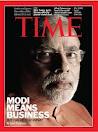
Gujarat Chief Minister Narendra Modi on the cover of the
26 March 2012 issue of the Time magazine of the U.S.


Hyderabad
17 March 2012

Making it to the cover of Time magazine may prompt two-time Gujarat chief minister Narendra Modi's followers to believe that he has it in him to lead India, but BJP's allies seem to think otherwise.

These parties seem to be making up their mind that the NDA's electoral prospects in the next parliamentary election, whenever it is called, would be better served without Modi in the lead. Some of them have suggested sotto-voce that the NDA could hope to become more acceptable to voters and allies -- present and potential -- alike, if the likes of a Narendra Modi or even an LK Advani are not projected as shadow premiers. They are calling it a minus formula, similar to the minus-one or minus-two formulae seen in the politics of neighbouring Bangladesh and Pakistan.

For one, the JD(U), which is the second largest constituent of the NDA, sees Modi as a liability and it does not fancy the idea of going to polls with him at the helm. More so, when JD(U) leader and Bihar chief minister Nitish Kumar himself is seen as a potential choice for prime minister. What goes in Nitish's favour, as compared to Modi, is the degree of acceptability towards him among non-BJP, non-Congress political parties, some of whom are coming together to constitute what is loosely being called a third or federal front comprising regional parties such as the Trinamul in West Bengal, BJD in Odisha, AIADMK in Tamil Nadu, and, now, SP in Uttar Pradesh, where Mulayam Singh Yadav's party has emerged the winner of the recently concluded Assembly election.

The third front is not without problems or internal contradictions, though. Complicating matters for this motley group is that there are many potential contenders for prime minister, including, but not limited to, Mamata Banerjee and Mulayam Singh Yadav. Already, Samajwadi Party sources have indicated that their next goal after getting a brute majority in the Uttar Pradesh Assembly is to make "Netaji", as Mulayam is called in his party, the prime minister. The SP has indicated its support to the UPA in the event of the Trinamul pulling out of the alliance and there it is speculated that the Congress could offer Mulayam a Cabinet berth to return the favour.

From the Deccan Chronicle, Bengaluru edition

From the Deccan Chronicle, Hyderabad edition

For its part, the Trinamul would not mind an early election because it is better placed than its rivals after winning the last Assembly election. However, if Congress veteran and finance minister Pranab Mukherjee is to be believed, Mamata has a huge challenge ahead of her simply because she is not fluent in Hindi. "If you don't know Hindi, you cannot be a prime minister. There are certain skills that are required for certain work. That is why Narasimha Rao became a good prime minister", Mr Mukherjee had famously remarked in 2009 when asked whether he was in contention for the top job. The language handicap notwithstanding, Mamata's Trinamul could emerge as the pivot of this front and a potential kingmaker in the event of a hung Parliament, where no party or alliance has absolute majority in the Lok Sabha.

Incidentally, the question asked about Modi has been used for Rahul Gandhi, too. A section of the Congress party is in favour of seeing the Gandhi scion succeed Prime Minister Manmohan Singh before the next parliamentary election, if only to enthuse party cadres and voters alike, but Congress President Sonia Gandhi has dismissed the possibility for now. Like cricketer Sachin Tendulkar, Dr Singh is faced with a career dilemma: they would want to know when is a good time to retire. Dr Singh's anxiety is compounded by the fact that for one who invested a large quantum of political capital in the UPA-1 on seeing the India-US nuclear deal through, even at the cost of risking his own government, he is today having to explain why nuclear projects in Tamil Nadu, Maharashtra and West Bengal have not taken off. Also, big-ticket reform measures such as entry of FDI of up to 51 per cent in multi-brand retail, or in insurance sector, has been put on hold for want of consensus among the UPA allies.