Showing posts with label Russia. Show all posts

‘BJP Under Modi Will Become Like Congress Under Indira’

This article was first published by Tehelka (www.tehelka.com) on 9 November 2014 under the headline BJP Under Modi Will Become Like Congress Under Indira


KN Govindacharya is not given to making statements merely for effect. Expect plain-speaking from the 71-year-old former RSS pracharak and former BJP ideologue, especially when the issues at hand are something he feels strongly about — the rise and rise of Amit Shah, the pitfalls of being a Narendra Modi or the degeneration of the BJP into an electoral machine. In an interview to RAMESH RAMACHANDRAN, he also says that the prime minister must be seen to act on black money and that the next Union Budget will be the best indicator yet of the thought process of the NDA government. Edited excerpts from an interview :


"Quote Unquote"

'BJP under Modi is vulnerable to the emergence of several Dev Kant Barooahs'

*******

'Indiscipline will become the order of the day in the BJP. If the party gets degenerated into just an electoral machine and the party, instead of being a party of workers with a mission, gets degenerated into a party of candidates for power — and instead of holistic growth, electoral gains become their parameters — then all this is bound to happen'

*******

'The next Budget will definitely be the indicator of the thought process of the BJP'

*******

'The Modi government has to present itself as pro-Bharat and pro-poor. There is a widespread perception that on certain issues the government is pro-Bharat, but it has to be translated at the policy level'

*******

'The Modi government needs to be much more forthcoming as far as actions are concerned. Just fond wishes won’t do. Just exclamations won’t suffice'

*******

'Mukesh Ambani patting Prime Minister Modi does not go down well with the cadres. The self-respect of the cadres is hurt'


It is nearly six months since Narendra Modi was sworn in as prime minister. How do you view his performance?
After Jawaharlal Nehru and Indira Gandhi, Narendra Modi has proved himself to be the most hardworking prime minister. He is also the most proactive. He has exhibited these two qualities. However, he has yet to learn the ropes of governance at the Centre. Now he is facing the arduous task of taming and then steering the bureaucracy because the whole structure, in spirit, is status-quoist, inert, corrupt and insensitive. Right from the peons to the secretary-level officials, passing-the-buck has been the greatest surviving strength of government employees. So, indecisiveness is another characteristic of the bureaucracy. As far as out-of-the-box thinking or breakthrough thinking is concerned, it is a far, far dream. So, now, Modi is facing this aspect of governance. It will be interesting to see how he fares in this context.

Similarly, you cannot differentiate between the two personalities of Modi and Amit Shah (BJP president) or, for that matter, between the party and the government. All rolled into one is the present picture. And it will continue to be so because Shah will not be seen as having any separate identity of his own. He will be just a shadow. He is yet to make a mark. So, with these things, naturally, there is always a liability or vulnerability of the emergence of several Dev Kant Barooahs. (Barooah was a former Congress president who famously said, “India is Indira. Indira is India.”) Only one was sufficient to damage the reputation. Here, that will become the way of working or the order of the day. So, it will be interesting to see how all these aspects are tackled.

What do you make of Prime Minister Modi’s pro-business image and some of the recent pronouncements by his government, particularly on issues such as black money?
Without imputing motives, I feel that the government needs to be much more forthcoming as far as actions are concerned. Just fond wishes won’t do. Just exclamations won’t suffice, but they have to be in unison with the action also. As Murli Manohar Joshi has also recently said (about politics and corporates), and I agree with him, a (Reliance Industries chairman) Mukesh Ambani patting Prime Minister Modi does not go down well with the cadres. The self-respect of the cadres is hurt. Because in this party, Nanaji Deshmukh (a founder of the Bharatiya Jana Sangh) used to have the best of relations with the industrialists but none of them could get into so much proximity and they were not given even the primary membership anywhere. But in the past 20 years, corporate houses have won Rajya Sabha seats also for some of their officials or ex-officials. So this nexus of political power and money power will definitely influence the formulation of policies also. It will be difficult for the political parties to strike a different line or mode that will be injurious or harmful to the interests of the corporates. So the people running the government must be aware of it and they should take precautions about it. That is why Modi was categorical that black money (“ek ek pai”; Hindi for every penny) will be brought back because that is the money of the poor. But, you see, this cannot match with his hobnobbing with the corporate sector.

Some view Modi as being autocratic. How would you describe his style of governance?
Modi has been working very smartly, so to say; he is an extraordinary performer when it comes to image, message, signals and politics. Nobody can match (him) and for that (to happen), a structure, technology and resources are needed. He has those things because of the party and the Sangh Parivar structures. Therefore, he is able to synchronise those three ­factors and that is his genius. One has to admit that, but that has to be translated into achievements at the ground level and it is in this context that I mentioned about the bureaucracy.

The Congress party is in disarray. A section of the media does not quite seem to have an appetite for being critical of the government. The judiciary is in need of reforms. In this situation, who do you think can effectively play the role of an Opposition?
The Opposition political parties have failed in their duties and they are not able to put their house in order. They are not able to digest their defeat or accept the reality that they have to rebuild the party; but how, they don’t know. They are also not clear about what should be their future strategy or planks of politics. On that count, the Opposition is nowhere to be seen. The media, for its part, has been rational enough to give time to this government before judging it or criticising it. They are acting fair enough, that is what I feel. As for the judiciary, it has come out openly with strong comments on black money and with regard to many other things; it has been vocal enough, assertive enough in its role. So I think that the media and the judiciary are indeed playing their roles, but the same cannot be said for the Opposition.

Can the Aam Aadmi Party (AAP) be more effective as an Opposition than as a government?
They have to acquire more skills for wielding power to protect and promote the interests of the people. So I think it was because of the distress and despair in the minds of the voters against the erstwhile ruling establishment that AAP was successful more than what they also might have expected. They have yet to build themselves into a political instrument. Their movement may have been helpful but consolidation was not there. So go-slow would have been the better strategy but they are the best people to judge for themselves.

Could the BJP-Shiv Sena split have been avoided before the Maharashtra Assembly election?
I think Modi is playing his game of politics in an assertive manner, given the numbers he has. And he has not trampled upon the toes of other political forces per se. Instead, for example, in Amritsar (Navjot Singh) Sidhu was sidelined; by whom? It was totally unfair and the BJP had to gulp it at that moment. About the Shiv Sena, that has not been the case but definitely, because of the split, realities have changed as far as Shiv Sena is concerned and, on the BJP’s side, they have not been unfair in demanding more seats. That was not good politics played by the Shiv Sena. So it is their fault. That fault can’t be heaped upon the BJP.

So where do the BJP and the Shiv Sena go from here?
They (Shiv Sena) also will learn lessons, which it is due for them. Efforts are always there but many a time efforts may not yield desired results. But I don’t think the BJP does not want allies or that it has become arrogant. That will be unfair to say. It depends on both partners; unilaterally, it is not possible. They should also be sensible enough to understand the change in the ground realities and the texture of politics. And it is not the end of the day; they should understand that it is a continuing process. What I am apprehensive about is how politics is turning power-centric and not people-centric, leadership-centric or personality-centric and not issue-centric. Politics is not merely about government or governance. It is about the direction in which the whole nation is to be steered by the State apparatus. It all depends on how you view the role of the State. Just winning elections or numbers is not the end of the road. The State is supposed to protect those who can’t protect themselves. So I see that in this respect, more sensitivity is required by all parties, including the ruling party.The issues of the poor and the deprived have to get more attention in this era of marketism and the State should be weighing itself in favour of the poor and the deprived rather than creating a perception that it is closer to the corporates.

Certain instances of indiscipline reported from Maharashtra have embarrassed the BJP…
It will become the order of the day. If the party gets degenerated into just an electoral machine and the party, instead of being a party of workers with a mission, gets degenerated into a party of candidates for power — and instead of holistic growth, electoral gains become their parameters — then all this is bound to happen.

The government has taken certain measures on the economic front but there is a view that more reforms are needed and quickly at that.
The situation will become clear in the next Budget because the last Budget was an extension of the previous government’s interim Budget. There was no original concept in it. The next Budget will definitely be the indicator of the thought process of the BJP. Till then, we have to wait as far as economic issues are concerned. Having said that, there is the issue of amendments to the Land Acquisition Bill, which the government is expected to bring in the winter session of Parliament. Then there are some cases on fast track against certain politicians… all of which is getting delayed. So I think one should not test the people’s patience beyond a limit. Six months is neither too early nor too late but the government has to present itself as pro-Bharat and pro-poor. There is a widespread perception that on certain issues the government is pro-Bharat, but it has to be translated at the policy level. For example, the ban on cow slaughter is not only an emotional issue; it is as well linked to economic and environmental aspects and also the direction of the development model. Breeding centres are needed. A couple of centuries ago, the cattle-to-man ratio was 7 to 1. At the time of Independence, it became 1 to 1 and now it is the reverse; today, the cattle-to-man ratio is 1 to 7. This is an alarming situation. It will definitely affect the health of the country, lead to malnutrition among children and the socio-psycho atmosphere will be hurt if this ratio further declines. The government can take certain steps such as ensuring that the export of beef and fodder is banned altogether. These seemingly innocuous steps can go a long way in addressing some of the problems. I intend to submit a memo to the government on the issue of cattle, specifically cows and their progeny.

The ‘trickle-down’ development model is a proven failure, so a departure is needed. Whether this government indeed does some out-of-the-box thinking remains to be seen. It will be interesting to see what is there in the Budget.

The government may be emotionally inclined towards being pro-Bharat but I think a lot needs to be done for the government to adopt a pro-poor approach. This aspect has to be geared for not merely lip service but a genuine commitment is needed. Eco-centric development is the need of the hour. fdi (foreign direct investment) and trickle-down theory won’t work and they will be detrimental to those people who are dependent on natural resources. Their livelihood will be threatened. Therefore, sensitivity and continuous exposure to that section of the people is needed, not investor summits.

Instead of practising the failed dictum of trickle-down theory, they should proceed towards eco-centric development and not merely anthropocentric development. An overdependence on the trickle-down theory can be counterproductive as it could encourage disparities and inequalities. Inclusive development and empowerment are needed, not through doles and charities but by the active participation of those sections of society and opening up avenues for that is the task of the government. There is a lot of talk about smart cities but hundreds of villages could vanish or be affected by the development of smart cities. Should smart cities then be a priority?

BJP veterans such as LK Advani and Murli Manohar Joshi have been sidelined. Could they have been treated differently?
If electoral politics is the approach, then whatever has been done is correct; but if politics is to be viewed holistically, then some more options could have been there. But, then again, there is no use discussing all those options. Gatham Gathaha… what has happened, has happened. One has to move on.

Concerns have been expressed in some quarters over the future of the Mahatma Gandhi National Rural Employment Guarantee Act (MGNREGA) and the Unique Identification (Aadhaar) Number — two schemes that had been launched by the erstwhile UPA government. Where do you stand on this issue?
Continuity and change are to be blended together. As it is said, old is gold but everything new may not be the best, so change and continuity should go hand in hand. Many alterations to MGNREGA are needed but more changes are needed in the legislation on land acquisition so that agricultural land is saved and the land that protects the interests of animals, birds and other living beings is protected. The interests of jal (water), jameen (land), jungle and jaanvar (animals) should be at least as important as that of humans. So I feel if the approach is altered from an anthropocentric development to eco-centric development, it will do more good.

What are your impressions about the government’s foreign policy?

I think the government is in a learning mode and needs more time to understand the ropes of foreign policy. It could definitely have better diplomatic and economic relations with Russia because they have been natural allies, geopolitically, in the past. China can be a competitor, if not a rival, but we will have to see how far this competition can be healthy.

NUCLEAR DISARMAMENT: Go beyond making pro forma noises

The first International Day for the Total Elimination of Nuclear Weapons will be observed on 26 September 2014. Will the Bhagavad Gita, which Robert Oppenheimer cited to explain his philosophy of life before and after the Trinity nuclear test of 1945, inspire Modi, Obama and their contemporaries in the comity of nations to do their duty by reducing the salience of nuclear weapons in international affairs?


New Delhi
25 September 2014

The redrawing of the boundaries of Ukraine may have come at an inopportune moment in the contemporary discourse on nuclear non-proliferation and disarmament. Ukraine’s dismemberment at the hands of Russia, coming as it did after it renounced what was the third largest nuclear arsenal in the world at the time of disintegration of the erstwhile Soviet Union, could impel certain nuclear holdouts to retain and refine their nuclear arsenals or spur some nuclear threshold states to cross the Rubicon and seek to insure themselves against potential violation of their sovereignties. It didn’t help that Russia also signalled its intention to finesse its security strategy by further developing its nuclear capabilities, which, in turn, has forced the US and NATO to revisit some of the underlying assumptions of their extant policies in eastern Europe. At the same time, those developments have once again brought to the fore and highlighted the perils of indiscriminate nuclear sabre-rattling and the human and humanitarian costs of atomic pursuits. Already, there are in excess of 16 thousand nuclear weapons worldwide today. According to a latest data published by an American magazine Bulletin of the Atomic Scientists, the largest concentrations of nuclear weapons are residing in Russia and the US, which together possess 93 per cent of the total global inventory; while Pakistan is reported to be quantitatively and qualitatively increasing its arsenal and deploying its weapons at more sites. Also, the failure of the nuclear-haves to break free from the vice-like grip of “Pehle Aap” (Hindi for you first or after you) culture, which pervades their thinking insofar as delegitimising the use of nuclear weapons and reducing their salience in international affairs are concerned, stands exposed. The entry into force of the Comprehensive Test Ban Treaty (CTBT), for instance, is held up on account of the inability of eight countries – the US, China, Egypt, India, Iran, Pakistan, Israel and North Korea – to sign and/or ratify it. The US has signed but not ratified the treaty, which China cites to defend itself; Pakistan, in turn, finds in India’s reluctance to even sign the treaty, let alone ratify it, a convenient escape clause for itself. Possibly, an early US ratification could have a domino effect on the remaining seven countries.

India’s own attempts at pushing for an international consensus on nuclear non-proliferation and disarmament date back to 1954 when Jawaharlal Nehru became the first statesman to call for a “stand still” agreement on nuclear testing after the US conducted a series of nuclear tests, including the detonation of a nuclear device that was equivalent to a thousand Hiroshimas, in the tiny Pacific Ocean archipelago of Marshall Islands. That was followed by Indira Gandhi’s joining five other heads of state and/or government in issuing the Appeal of May 1984 to draw world attention to nuclear disarmament and Rajiv Gandhi’s now eponymously-named “Action Plan to usher in a worId order free of nuclear weapons and rooted in non-violence” that was unveiled on 9 June 1988 at the United Nations General Assembly. However, by then India had decidedly begun to embrace a foreign- and security policy that was dictated by realpolitik; and the nuclear tests by India in 1998 validated it. The consequent decline in India’s moral stature and political will ensured that her voice on disarmament remained feeble. However, it was around the same time that Kazakhstan was making itself heard, first by renouncing its nuclear arsenal and subsequently by forging a Central Asia Nuclear Weapon Free Zone Treaty, which was signed by all five Central Asian states – Kazakhstan, Turkmenistan, Tajikistan, Uzbekistan and Kyrgyzstan. On 2 December 2009, the 64th session of the United Nations General Assembly accepted Kazakhstan’s proposal for declaring 29 August as the International Day Against Nuclear Tests. On this occasion last month, the victims of nuclear tests such as a 46-year-old armless painter Karipbek Kuyukov and the Hibayushas (Japanese for survivors of an explosion) of Hiroshima and Nagasaki came together to shake off the international community’s inertia and to urge them to expedite disarmament talks which are otherwise progressing at a glacial pace. Kazakhstan’s efforts towards a global test ban, leading to an eventual ban on nuclear weapons, needs to be admired in India and around the world.

The way forward

Kazakhstan, Japan or Marshall Islands are not alone in their endeavours. Joining them in a campaign to showcase the humanitarian costs of nuclear tests and nuclear weapons are Norway and Mexico, which hosted the first two editions of a global conference. Austria will host a third in December this year. Considering India’s own past efforts at campaigning for disarmament, it would do well to consider making common cause with like-minded countries such as Japan and Kazakhstan. The essential features of the four-fold Rajiv Gandhi Action Plan are similar to the four specific steps that Japan’s foreign minister Fumio Kishida articulated recently in an article published by Foreign Affairs, a leading American magazine on international relations. For his part, Prime Minister Narendra Modi could use his talks with world leaders and his intervention at the United Nations General Assembly this year to signal his government’s intent. Mr Modi has already said in an interaction with Japanese journalists on the eve of his just concluded visit to Tokyo that “there is no contradiction in our mind between being a nuclear weapon state and contributing actively to global nuclear disarmament and non-proliferation.” Incidentally, the first International Day for the Total Elimination of Nuclear Weapons will be observed on 26 September, on the eve of Prime Minister Modi’s address to the 69th Session of the United Nations General Assembly in New York. According to the United Nations, “As of 2014, not one nuclear weapon has been physically destroyed pursuant to a treaty, bilateral or multilateral and no nuclear disarmament negotiations are underway.  Meanwhile, the doctrine of nuclear deterrence persists as an element in the security policies of all possessor states and their nuclear allies. This is so despite growing concerns worldwide over the catastrophic humanitarian consequences of the use of even a single nuclear weapon, let alone a regional or global nuclear war.” In 2015, the NPT (Non-Proliferation Treaty) Review Conference will take place; the year will also mark the 70th anniversary of the Hiroshima-Nagasaki bombings. Also, the United Nations plans to convene no later than 2018 a high-level international conference on nuclear disarmament to review the progress made in this regard. All these occasions could be used by the international community to discuss nuclear non-proliferation and disarmament. A push for a global no-first-use could be a good starting point of those talks, to begin with.

Prime Minister Narendra Modi with his Japanese counterpart Shinzo Abe
Although Mr Modi has iterated India’s commitment to a universal, non-discriminatory and global nuclear disarmament and a unilateral and voluntary moratorium on nuclear explosive testing, Japan’s special sensitivities continue to cause a delay in signing of a civilian nuclear cooperation agreement with India. In such a situation, even a tentative first step in this direction would endear India to those sections of the Japanese society that remain sceptical of civil nuclear cooperation with a non-NPT and non-CTBT country such as India. Towards the end of his visit to Japan, Mr Modi had said that he had gifted copies of the Bhagavad Gita to his Japanese interlocutors, including the Emperor. He explained his actions thus: “I have nothing more valuable to give and the world has nothing more valuable to get.” Hopefully, going forward, the Bhagavad Gita would help resolve the moral dilemmas confronting many a world leader and stir their collective conscience to do their duty. As for Mr Modi himself, he maintains that he is an incorrigible optimist. “Some people say a glass is half empty; some people say a glass is half full. I say the glass is half filled with water and half filled with air,” he had told the BJP Parliamentary Party, by way of an explanation, soon after he led the party to a historic win in the May 2014 parliamentary elections. That personal philosophy of Mr Modi could come in handy for India as it negotiates a minefield that is the contemporary global discourse on nuclear non-proliferation and disarmament.

Will the Bhagavad Gita do to the leaders of India and the United States what Lord Krishna did to Arjuna on the battlefield of Kurukshetra in the Mahabharata? Will the Bhagavad Gita, which Robert Oppenheimer cited to explain his philosophy of life before and after the Trinity nuclear test of 1945, inspire Modi, Obama and their contemporaries in the comity of nations to do their duty by reducing the salience of nuclear weapons in international affairs?

NUCLEAR FRISSON !

* This article was first published by Tehelka (http://www.tehelka.com) weekly magazine on 12 September 2014 under the headline The Nuclear Disarmament Mess.

------- + -------

Why India could join hands with Japan and Kazakhstan to push the world on the road to nuclear disarmament, says Ramesh Ramachandran

Pix Courtesy: Reuters

Astana and Semey in Kazakhstan
29 August 2014
On 29 August, Prime Minister Narendra Modi met with a group of Japanese journalists ahead of his visit to Tokyo and sought to reassure them about India’s commitment to universal, non-discriminatory and global nuclear disarmament and a unilateral and voluntary moratorium on nuclear explosive testing. The same day, in the far-away steppes of Kazakhstan, former Japanese diplomat Yasuyoshi Komizo joined the locals of Semey, a small town located on the banks of the Irtysh river, bordering Russia, to mark the International Day Against Nuclear Tests by observing a moment’s silence in honour of all victims, living and dead, of nuclear tests.

Komizo, 66, who now serves as the chairperson of Hiroshima Peace Culture Foundation and the secretary general of Mayors for Peace, also planted a sapling of the Gingko Bilopa tree, which survived the 6 August 1945 atomic bombing of Hiroshima.

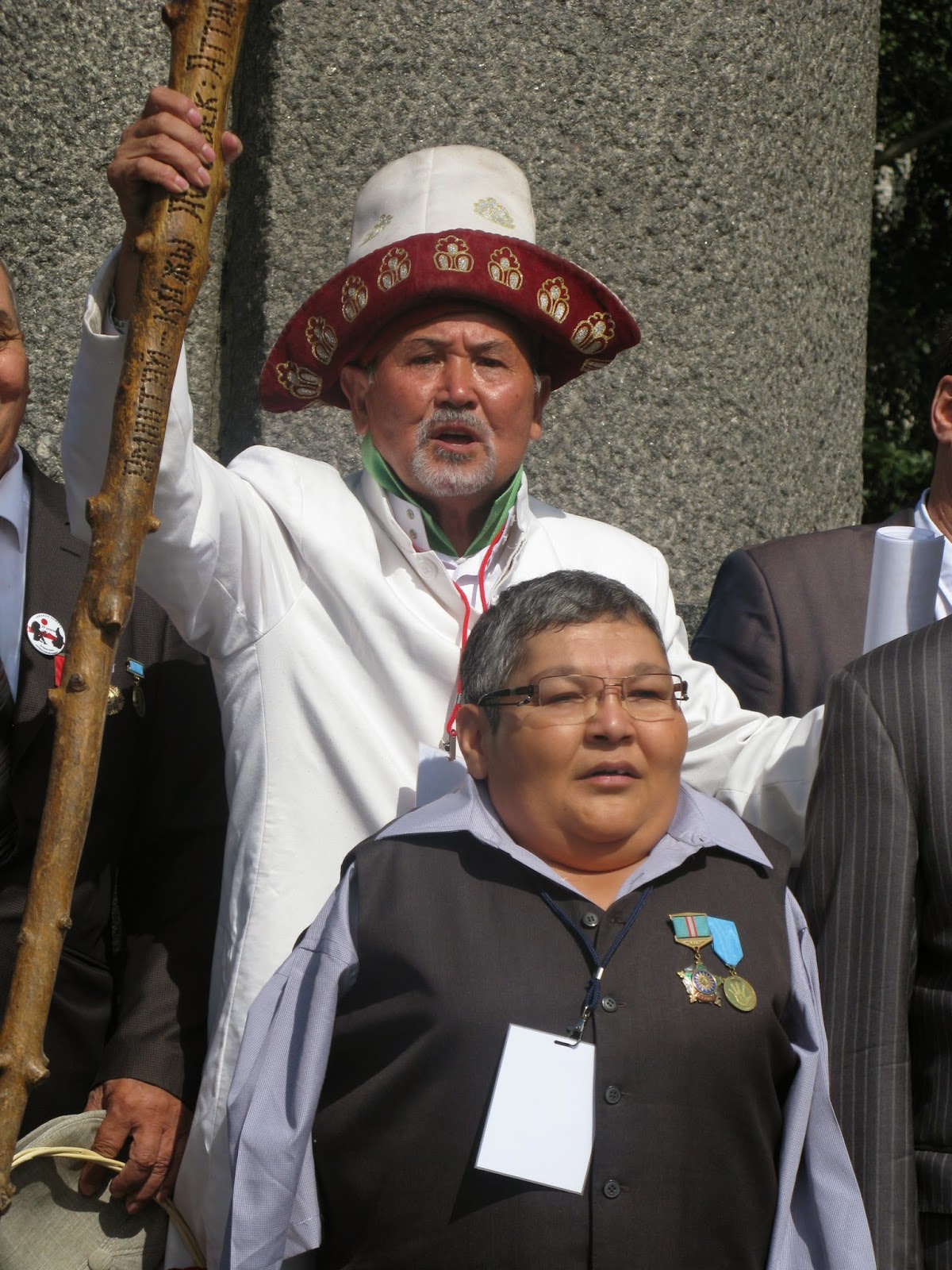
Present on the occasion was armless Kazakh painter Karipbek Kuyukov, 46, who is a second-generation victim of the nuclear tests at Semey and the face of the anti-nuclear movement in Kazakhstan.

Kuyukov, who holds a brush in his mouth or between his toes to give expression to his creative spirit, was born near Semey and is one of more than 1.5 million people, as per a United Nations estimate, who suffered the consequences of nuclear testing.

Today, he divides his time between painting and campaigning for a global ban on nuclear tests as an honorary ambassador of The ATOM Project (an acronym for Abolish Testing. Our Mission), which Kazakhstan President Nursultan Nazarbayev launched on 29 August 2012.

The coming together of the victims of nuclear tests such as Kuyukov and the Hibayushas (Japanese for survivors of an explosion) of Hiroshima and Nagasaki, the only victims of atomic bombings, is instructive for India and the world.

A Study In Contrast

The Republic of Kazakhstan was not even born when the late Indian prime minister Rajiv Gandhi unveiled his now eponymously-named “action plan to usher in a world order free of nuclear weapons and rooted in non-violence”, on 9 June 1988 at the UN General Assembly.

However, since then, while India’s moral heft and political will to pursue the twin issues of non-proliferation and disarmament to a logical conclusion have seen a decline, Kazakhstan — undaunted by the prospect of a David versus Goliath battle or unfazed by the criticism of not making enough progress towards genuine media and political freedoms — has taken upon itself to champion the cause of a global test ban leading to an eventual ban on nuclear weapons. And it has all the right credentials, to boot.

On 28 February 1989, a poet-activist by the name of Olzhas Suleimenov, now 78, founded the Nevada- Semey anti-nuclear movement to mobilise public opinion against the nuclear explosions conducted by the then USSR at the Semey (formerly Semipalatinsk) test site and to show solidarity with similar movements in the US for closing down the Nevada nuclear test site.

A groundswell of public opinion following the launch of the movement ensured that the erstwhile USSR did not conduct another nuclear test at Semey after 19 October 1989 (although it would not be until after the 24 October 1990 test at Novaya Zemlya, an archipelago in the Arctic Ocean, that the erstwhile USSR completely stopped all nuclear tests.)

On 29 August 1991, Nazarbayev, president of what was then the Kazakh Soviet Socialist Republic, officially shut down the Semey nuclear test site. (Kazakhstan became an independent country on 16 December 1991.) It brought to an end a 40-year-long history of nuclear tests at Semey, which began on 29 August 1949; a total of 456 tests (including 116 above-ground tests) were conducted at Semey. He followed it up by announcing that Kazakhstan would voluntarily renounce its nuclear arsenal — the fourth largest in the world at the time — that it had inherited from the erstwhile USSR.

That process was completed by 1996 but his ambitious endeavours didn’t stop there. Next on his agenda was a Central Asia Nuclear Weapon Free Zone Treaty, which was signed by all five Central Asian States — Kazakhstan, Turkmenistan, Tajikistan, Uzbekistan and Kyrgyzstan — on 8 September 2006 at Semey and came into force in 2009. This May, all five permanent members of the UN Security Council signed the protocol to this treaty, giving negative security assurances and committing themselves not to use nuclear weapons against the Central Asian States.

On 2 December 2009, the 64th session of the UN General Assembly accepted Kazakhstan’s proposal for declaring 29 August as the International Day Against Nuclear Tests. The Resolution 64/35, which was adopted unanimously, called for increasing awareness “about the effects of nuclear weapon test explosions or any other nuclear explosions and the need for their cessation as one of the means of achieving the goal of a nuclear-weapon-free world”. (India and seven other countries — China, Pakistan, the US, Iran, North Korea, Israel and Egypt — are still to sign and/or ratify the Comprehensive Nuclear- Test-Ban Treaty or the CTBT.)

During his visit to Semey in April 2010, UN Secretary General Ban Ki-moon urged the leaders of all countries, especially the nuclear powers, to follow the example of Kazakhstan on disarmament and non-proliferation.

In memoriam People gather at the Stronger than Death Monument in Semey, Kazakhstan, to mark the International Day Against Nuclear Tests on 29 August
Pix courtesy: Ramesh Ramachandran
Among the latest to join countries such as Kazakhstan and Japan in a concerted campaign for a global test ban leading to eventual disarmament is Marshall Islands, a tiny archipelago in the Pacific Ocean, where the US had conducted a series of nuclear tests, including the detonation of a nuclear device that was equivalent to a thousand Hiroshimas. (In April this year, Marshall Islands filed a lawsuit against India and eight other nuclear-armed countries at the International Court of Justice at The Hague for not disarming themselves.)

In comparison, India’s quest for a nuclear-free world dates back to 1954 when the late prime minister Jawaharlal Nehru became the first statesman to call for a “stand still” agreement on nuclear testing. Three decades later, the late prime minister Indira Gandhi joined five other heads of state and/or government in issuing the Appeal of May 1984 to refocus the world’s attention on nuclear disarmament. However, by then a combination of circumstances and national security imperatives had already begun impelling India towards effecting a shift from a foreign and security policy based on moral considerations to one that was dictated by realpolitik; the nuclear tests by India in 1998 are a case in point.

As Rajiv Gandhi had said in his 1988 speech, “Left to ourselves, we would not want to touch nuclear weapons. But when, in the passing play of great power rivalries, tactical considerations are allowed to take precedence over the imperatives of nuclear non-proliferation, with what leeway are we left?”

Reconciling Dilemmas

To the proponents of non-proliferation and disarmament, the discourse in India today, unlike the time when it sought to punch above its weight in the international arena, has markedly shifted away from a moral self-righteousness to the pursuit of a foreign policy bereft of a moral compass. Yet, there is an overwhelming body of opinion, both within the government and without, that India can and must play an effective role in working towards attaining the goal of disarmament. As Prime Minister Modi himself said in his interaction with the Japanese journalists in New Delhi, “There is no contradiction in our mind between being a nuclear weapon state and contributing actively to global nuclear disarmament and non-proliferation.”

He iterated India’s position a second time, this time during the course of an interaction with the students of Sacred Heart University in Tokyo, that India’s commitment to non-violence is total; it is ingrained in the “DNA of Indian society and this is above any international treaty”. Modi went on to assert that “India is the land of Lord Buddha. Buddha lived for peace and suffered for peace and that message is prevalent in India.”

On the face of it, Modi’s remarks are consistent with those of his predecessors, particularly Manmohan Singh, who had wrestled with the pros and cons of disarmament in the light of the relevance (or lack thereof ) of the Rajiv Gandhi Action Plan and India’s moral stature in pushing for a global consensus on the issue.

A committee constituted in the second term of Manmohan Singh had recommended, among other things, that India should lead the campaign for disarmament because over the decades, it has been in the forefront of such efforts and its emergence as a power to be reckoned with would further enable it in this endeavour.

The Road Ahead

What Rajiv Gandhi said in his 1988 speech rings true even today: “Humanity is at a crossroads. One road will take us like lemmings to our own suicide. (The) other road will give us another chance.”

Surely, the latter road passes through Semey. The least India can and must do is to lend its voice and weight to the efforts being championed by Kazakhstan and Japan alike. The essential features of the four-fold Rajiv Gandhi Action Plan are similar to the four specific steps that Japanese Foreign Minister Fumio Kishida articulated recently in an article published by Foreign Affairs, a leading American magazine on international relations. In the article, Kishida, who, incidentally, hails from Hiroshima, hoped that a consensus could be reached at the 2015 NPT (Non-Proliferation Treaty) Review Conference on a new plan of action to reduce nuclear weapons and ensure non-proliferation.

The year 2015 would also mark the 70th anniversary of the Hiroshima-Nagasaki bombings. New Delhi and Tokyo would do well to dovetail their efforts for greater synergy. Doing so will also endear India to those sections of the Japanese society that remain sceptical of civil nuclear cooperation with a non-NPT and non-CTBT country such as India.

For its part, Kazakhstan has listed nuclear disarmament and non-proliferation among its key foreign policy priorities in the event of its election as a non-permanent member of the UN Security Council for the 2017-18 period. As for India, Prime Minister Modi’s talks with the leaders of China and the US and his intervention at the UN General Assembly this month should be a good starting point for it to lay out its vision for reducing the salience of nuclear weapons in international affairs. Therefore, going forward, there is ample scope for India, Japan and Kazakhstan to coordinate their positions.

For if, as Modi said, the friendship between India and Japan will determine what the “Asian century” will look like, then it behoves of them to partner like-minded Asian countries such as Kazakhstan for an alternative universality. A 2012 strategy document, titled ‘Nonalignment 2.0: A foreign and strategic policy for India in the 21st century’, published by the New Delhi-based think-tank Centre for Policy Research, had concluded that “India should aim not just at being powerful. It should set new standards for what the powerful must do.”

In a similar vein, Jonathan Granoff, president of the US-based Global Security Institute, had said on the occasion of the 20th anniversary of the Rajiv Gandhi Action Plan in 2008 that “the world needs the compass point of leadership”. Will India, and Modi, oblige?


The Armless Crusader
Painter Karipbek Kuyukov is a living testimony to the damage caused by radioactive fallout from nuclear testing, says Ramesh Ramachandran

Trailblazer Karipbek Kuyukov
Pix courtesy: Ramesh Ramachandran
The remoteness of Semey (formerly Semipalatinsk) proved to be its undoing. A land that was once home to Kazakhstan’s most famous poet, Abai Kunanbayev, or the place where Russian writer Fyodor Dostoevsky of Crime and Punishment fame was exiled to, is today infamous for the nuclear pursuits of the erstwhile Soviet Union. The Cold War saw the Soviets use the vast steppe around Semey for conducting a series of nuclear tests. Consequently, this nondescript town, which today has a population of only a little over 300,000, has seen some of the worst human, man-made tragedies.

Karipbek Kuyukov, 46, is a living testimony of the damage caused by radioactive fallout from the explosions. He was born in 1968 in the village of Yegyndybulak, about a 100 km away from Semey, where the former Soviet Union tested its nuclear weapons between 1949 and 1989. Little did his unsuspecting parents know that years of indiscriminate nuclear testing during the Cold War would rob their son of the simple pleasures of life that you and I, who are far removed from the steppes of Kazakhstan, would take for granted. Kuyukov was born without arms — an unwitting victim of his parents’ exposure to nuclear radiation.

“When I was a child, my parents used to tell me stories about how the ground trembled,” Kuyukov recalls. “Growing up, I remember the armoires shaking and the rattling of dishes.”

He spent an early part of his life at an institute in St Petersburg (formerly Leningrad), where his father hoped he would learn to use prosthetic arms. The young Kuyukov tried but failed to master the prosthetic; he wouldn’t tell if it militated against his aesthetic sensibilities but he lets you in on his intimate thoughts and how and why he chose art to give expression to his creative talent. “My soul was looking to create something beautiful,” he reminisces.

What began as a painfully slow and exhausting attempt at redeeming himself eventually transformed into a cathartic, and almost transcendental, experience — one that would not only give meaning to his life but hold him up as a conscience-keeper for generations to come.

“I will be the happiest if I am among the last victims of nuclear tests,” says the diminutive painter, who has made it his life’s mission to encourage people, as opposed to governments, to seek a ban on nuclear tests and to make a world free of nuclear weapons a reality. Left to themselves, governments will forever cite reasons for holding on to their nuclear arsenals but people can turn the tide when they force governments to sit up and take notice of the will of the people, he reasons. And that is the message he seeks to convey through his paintings. Holding a brush in his mouth and between his toes, Kuyukov has painted on themes ranging from fear and loneliness to the mushroom cloud and nature.

“Through my works, I want to share with the people the horrible consequences of nuclear tests, the pain and suffering of the victims of nuclear tests and the agony of mothers,” he says. Today, he spends a considerable part of his time campaigning for a ban on nuclear tests in his capacity as an honorary ambassador for The ATOM Project. (The ATOM Project is a global petition drive to mobilise international public opinion against nuclear tests and to deliver those petitions with signatures to the leaders of the countries with nuclear weapons.)

“The last 25 years of my life have been a battle. When I joined the movement, I remember that in those days when neither the Internet nor mobile phones existed, we collected signatures on sheets of paper from every region,” Kuyukov says. “I don’t have arms to hug you but I have a heart and it belongs to you!”

According to The ATOM Project, “Today, many in the area around the former Semipalatinsk nuclear test site (or The Polygon, as it was known) do not live past 60 and, as a result of exposure to radiation, the genetic code of those parents and grandparents was permanently altered, resulting in horrific birth defects to this day. According to the UN, in all, more than 1.5 million people in Kazakhstan are believed to have suffered premature death, horrible radiation-related diseases and lifetimes of struggle as a result of birth defects.”

The ATOM Project has designated 11.05 am (the local time in respective countries) on 29 August of every year as the occasion to observe a moment’s silence in honour of all victims of nuclear tests. At 11.05 am, the hands of a clock form a ‘V’ for victory and it therefore chose this time to signify a victory of common sense over fear and for global efforts towards a nuclear weapons-free world.

After US and Russia, France reassures India on clean NSG waiver

New Delhi
1 July 2011

After the United States and Russia, France has iterated its commitment to full civil
nuclear cooperation with India.

The French government has said that the Nuclear Suppliers Group's (NSG's) recent
decision, to bar transfer of sensitive enrichment and reprocessing technologies to non-
NPT signatories, does not undermine the waiver granted to India in September 2008.

"The decision taken by the NSG is not a measure targeting any particular State. This
decision is the fruit of prolonged discussions initiated in 2004. Coming after the decision
of exemption from the full-scope safeguards clause, adopted in favour of India in
September 2008, it does not undermine the principles of this exemption," Jerome
Bonnafont, the French ambassador to India, said.

In a statement, the envoy also said, "France confirms that this NSG decision in no way
undermines the parameters of our bilateral cooperation, and is committed to the full
implementation of our cooperation agreement on the development of peaceful uses of
nuclear energy signed on September 30, 2008."

Bonnafont emphasised that France was strongly committed to the development of an innovative, broad-based and dynamic civilian nuclear cooperation with India.

The NSG held its plenary at Noordwijk in the Netherlands in June.

Further, Bonnafont said President Nicolas Sarkozy of France announced his support for India's membership of four multilateral export control regimes during his visit to India in December 2010, and
France iterated its "full and complete support" to India's membership of the NSG in
its meeting which concluded on June 24.

In September 2008, France became the first country to sign a bilateral civilian nuclear
accord with India after the NSG granted a landmark waiver to New Delhi, reopening
global civilian nuclear commerce after a gap of 34 years. The French envoy's assurance
on his country's commitment to full civilian nuclear cooperation came a day after
outgoing US ambassador Timothy Roemer stressed that Washington was firmly
committed to NSG's clean waiver to India.

After the 2006 vote against Iran, India abstains on Syria, but questions remain


(L) President Bashar al-Assad of Syria, and, on the right, IAEA Director General Yukiya Amano

New Delhi
10 June 2011

India abstained in Thursday's (9 June 2011) vote in the International Atomic
Energy Agency (IAEA), which decided to report Syria to the United Nations security
council (UNSC) over its alleged covert nuclear programme.

The 35-member board of governors of the Vienna-based UN nuclear watchdog decided by
a 17-to-six vote, with 11 abstentions, to refer Syria to the UNSC for building an
undeclared nuclear reactor at a site in Dair Alzour (which was unilaterally destroyed by
Israel in 2007), for not allowing the IAEA to carry out investigations, and for not adhering
to its safeguards agreements.

The last time the IAEA reported a member-state to the UNSC was Iran in February 2006.
India's votes against Iran had been widely criticised at home, but Thursday's abstention
did not go unchallenged either.

A section of the official circles described India's decision to abstain, and to not cast a 'no
vote' along with Russia and the others, as being dictated by a desire to keep the US and
Israel in good humour. It felt that the IAEA vote was meant to bully President Bashar al-
Assad of Syria into submission and to set in motion a process to effect a regime change
(similar to Libya) in order to disrupt the Syria-Iran axis.

However, New Delhi defended itself by maintaining that states were required to comply
with safeguards obligations and it has consistently been against clandestine
proliferation. At the same time, it pointed out, scope for dialogue should be fully utilised.

The IAEA's referral of Syria to the UNSC should be seen in the context of the attempts by
the West to push for a UNSC resolution condemning Syria's crackdown on protesters.
With Russia indicating that it might veto any such UNSC resolution against Syria, New
Delhi was of the opinion that putting it to vote in the 15-member UNSC, of which India is a
non-permanent member, would be pointless.

In Thursday's vote, 17 countries voted for reporting Syria to the UNSC. They were: the
US, the UK, France, the Netherlands, Portugal, Singapore, Germany, Italy, Japan, South
Korea, Australia, Belgium, Cameron, Canada, Czech Republic, Denmark, and the UAE.
Six countries voted against the motion: China, Russia, Pakistan, Ecuador, Venezuela
and Azerbaijan. India and 10 other countries abstained, which included Argentina, Brazil,
Chile, South Africa, Peru, Jordan, Kenya, Niger, Tunisia, and Ukraine. Mongolia was absent
from the vote.