Showing posts with label Congress. Show all posts

The Challenge Before Rahul Gandhi

This article was first published by Tehelka (www.tehelka.com) under the headline The Challenge Before Rahul.


Will the Gandhi scion be able to overcome the prevailing sentiment against the politics of dynasty?

DK Shivakumar’s mandate may be confined to Karnataka by virtue of his being a minister there but his sentiments seem to transcend the state’s borders and find resonance with a section of the Congress party’s central leaders. That is not to say that no one in the party’s central leadership had thought on those lines before or aired similar sentiments in the past.

Chidambaram and (right) Kalam Nath
In fact, first off the blocks was Kamal Nath, who, soon after the Congress debacle in the recent Lok Sabha election, sought to suggest that the party organisation was in dire need of an overhaul. He articulated as much in an interview to NDTV, in which he spoke about holding of elections to the Congress Working Committee. Perhaps, he added for good measure, it was time to put an end to the prevailing culture of patronage, too. Most recently, P Chidambaram told the same television channel that an individual from outside the Gandhi family could “someday” take over the reins of the party.


Not being exceptionally media-savvy or not having a Twitter account should be the least of Congress vice-president Rahul Gandhi’s worries today. (Not that having a presence on social media is a bad idea.) For one who claims to have spent the better part of the past seven years reorganising the Youth Congress, he does not have much to show by way of outcomes. A straw poll would indicate that there is still a deep-seated resentment among a section of the Youth Congress activists at the manner in which the Gandhi scion has gone about ushering in purported reforms, which have been implemented more in the breach.

When Rahul came to head the Youth Congress in 2007, he spoke about democratising the organisation by regularly holding elections, but a common refrain even today is that family connections matter more than merit in the party and its various organs.

One sentiment that clearly emerges from interacting with some of the workers is that the Congress party seems to be woefully out of sync with the prevailing sentiment, inside and outside the party and in India’s hinterland, against the politics of dynasty and entitlement.

The asymmetry between the two principal political parties in the country today becomes even more pronounced when one considers who the Gandhis — Sonia and Rahul — are pitted against: Narendra Modi, who rose from being a chaiwallah in his childhood to occupy the highest office in the land, and Amit Shah, who rose from within the ranks to head the BJP. In such a situation, to rope in another dynast from the same family — Priyanka Gandhi Vadra — in the hope that she would pull the party out of the morass it finds itself in, is hardly going to be a solution. (The irony is unmistakable: The same Congress worker who rails against nepotism sees Priyanka as a saviour who will wave the proverbial magic wand and, voila!, make it all look good again. For her part, she has indicated time and again that she is not ready and willing yet to play a more active role in the party’s affairs.)

It should not come as a surprise that the Congress rank and file feels a sense of despair, made even more acute by the perceived absence of Rahul from the party’s affairs post the Maharashtra and Haryana Assembly elections. Incidentally, Rahul is a key part of a 12-member Congress committee constituted to “look into future challenges” but the nature and contours of the deliberations undertaken by this panel remain a mystery.

Similarly, the conclusions or recommendations by a committee set up under the chairmanship of AK Antony to examine the reasons for the party’s debacle in the Lok Sabha election did not help matters by absolving the party office-bearers of all responsibility. Instead, the committee’s report sought to ascribe the party’s loss to unspecified organisational handicaps and, oddly, manipulation of the media by its rival. Admittedly, winning isn’t everything but then again, you don’t win silver, you lose gold!

For a party that practically invented the art of election engineering, to commit the same mistake that its rivals did some decades ago is unforgivable. (In a sense, it speaks to the bankruptcy of the Congress’ present-day leaders.) The late Indira Gandhi won a landslide in 1971 on the back of a simple yet effective slogan of “Woh kehte hain Indira hatao, main kehti hoon garibi hatao (They are saying remove Indira, I’m saying remove poverty.)” The more her rivals (who had banded together in a grand alliance) conducted a personalised campaign against her, the more she gained. Cut to 2014, and the same Congress party targeted Modi at the expense of everything else, and ended up handing him an unprecedented victory at the hustings.

The Congress strategists seem to have forgotten that there is something called a law of diminishing returns and the effectiveness of a unidimensional campaign begins to wear off after a certain period of time. And this stratagem of the Congress to selectively target Modi will continue to bother the party if, as is being anticipated, it gangs up with some of its ‘secular’ allies against a resurgent bjp and trains its guns on Modi in the states where elections are due. The Congress needs to change tack to counter the Modi phenomenon.

If Rahul is missing in action, so are certain erstwhile Congress ministers who seem to have gone into hibernation after the Lok Sabha election. The alacrity with which some of them have resumed their professional careers sends out the wrong signal that they are abandoning the party when it needs their services the most. Consequently, the task of articulating the party’s views has been outsourced ad hoc to individuals who lack the requisite skills or the stature to make forceful interventions.

For the Congress party and its brains trust, now is not the time for window dressing; now is the time for a dressing down. Cosmetic surgery won’t do anymore. Rahul will have to lead from the front and ensure that his interventions are consistent, not sporadic. His cameos such as the ordinance-is-complete-nonsense-it- should-be-torn-up-and-thrown-away or his aggressive speech at the All India Congress Committee session in January this year have proved inadequate, sometimes counter-productive. On 28 October, Rahul met with his colleagues in what was only his first formal interaction with them after the recent round of Assembly elections. On the occasion, he touched upon the issue of holding organisational elections that would be transparent and fair. It remains to be seen how effective those elections prove to be in infusing new vigour into the party.

A reluctant politician Rahul might be but there is a thin line that divides being reluctant from being (or coming across as being) disinterested. This was brought out starkly earlier this year in Rahul’s interview to Times Now television channel. He was asked: “Had you not been a Gandhi, would you have been in politics at all?” His reply was neither categorical nor in the affirmative. The import of that silence (reticence?) was not lost on a discerning audience, some of whom wondered why the tenets of equal opportunity and internal democracy should not extend to his job.

As the party introspects and contemplates its future course of action, it could begin with rightsizing its top-heavy organisation, rejigging its team of officebearers at the national and state levels and spotting new talent within and outside the party, instead of paying a lefthanded compliment to the bjp by iterating that the latter marketed itself better in the Lok Sabha polls. As Chidambaram warned, the morale is low and the party’s leadership must respond urgently.

The question before the Gandhis is: would they rather perpetuate themselves than see the party revive and reinvent itself in keeping with the times we live in?

If the party survives, so will the Gandhis.

Early Warning Sign

This article was first published by Tehelka (www.tehelka.com) on 18 September 2014 under the headline "An Early Warning"

Rude awakening: Narendra Modi and Amit Shah have their task cut out for them and there is neither room for complacency nor scope for hubris
What do the bypoll results mean for the BJP and Narendra Modi? Ramesh Ramachandran and Virendra Nath Bhatt try to find some answers

It may be too early to conclude that the results of the recently concluded bypolls in nine states, particularly Uttar Pradesh and Rajasthan and to a lesser extent Gujarat, are a referendum of sorts on Prime Minister Narendra Modi’s 100-odd-day-old government or, conversely, signal a Congress recovery after its humiliating loss in the recent General Election.

At best, they could and probably should be seen as an early warning for the BJP and its affiliates whose impulse has been to pick the low-hanging fruit in the form of, say, appealing to the baser instincts of man a la ‘love jihad’ than to making a concerted effort to build on attempts by BJP patriarchs Atal Bihari Vajpayee and LK Advani to make the BJP the natural party of governance.

Bypolls have now been held in 54 Assembly constituencies across 14 states (Uttarakhand in July; Bihar, Madhya Pradesh, Punjab and Karnataka in August; and Uttar Pradesh, Rajasthan, Gujarat, Andhra Pradesh, Chhattisgarh, Assam, West Bengal, Tripura and Sikkim in September) since the BJP-led NDA government came to power on 26 May. The BJP and its alliance partners had held 36 of those Assembly seats but they have managed to retain only 20 of them.

Whither Modi wave?

The BJP rode on Modi’s popularity to an unprecedented win in the General Election when it won 71 out of 80 seats in Uttar Pradesh, all 25 seats in Rajasthan and all 26 seats in Gujarat. Amit Shah, who has since taken over as BJP chief, was largely seen as the architect of the party’s strategy in Uttar Pradesh. Cut to September and the party suffers a setback in varying degrees in each of those states, which is why the contrast is that much starker.

In Uttar Pradesh, Rajasthan and Gujarat, which together account for 24 Assembly seats where bypolls were held, the BJP retained only 10 seats (it had 23 seats going in to the bypolls) while its ally, Apna Dal, lost the Rohaniya seat — which falls in the Varanasi parliamentary constituency held by Modi — to the Samajwadi Party (SP).

Apna Dal national president Krishna Patel only managed to garner 61,672 votes, whereas in the Lok Sabha election, Modi had polled 1.19 lakh votes from this Assembly segment alone. (Krishna Patel’s daughter Anupriya was the sitting MLA from Rohaniya when she was elected as the MP from Mirzapur.)

In Rajasthan, the Congress wrested the Nasirabad, Weir and Surajgarh seats from BJP, leaving the latter with only one win in Kota. Similarly, in Gujarat, the Congress won three seats and the BJP six.

The only consolation for the BJP was that it made its debut in the West Bengal Assembly by winning the Basirhat Dakshin seat.

Predictably, BJP spokespersons maintain that the bypolls results are not a reflection on Narendra Modi’s government or governance. They are quick to point out that bypolls in Assembly constituencies, as opposed to Lok Sabha seats, are generally fought on local issues and therefore too much should not be read into the results.

The Congress, on the other hand, claims that the verdict is a clear indication that voters have rejected the divisive politics practised by the BJP. Although some Congress office-bearers went overboard in their assessments of the party’s performance in the Rajasthan and Gujarat bypolls, the only sobering voice was that of Shakeel Ahmad, a general secretary and a spokesman of the party, who sought to suggest that although the verdict is more against the BJP than for a particular party, it would be incorrect to write it off or to say that the BJP has been rendered inconsequential. What Ahmad leaves unsaid is that the Congress was in a similar situation 10 years ago when it performed badly in the bypolls that were held immediately after the UPA came to power in 2004.

History bears it out, too. The party that wins a Lok Sabha election tends to perform below par in the Assembly bypolls immediately afterwards, especially if the Centre and the state(s) concerned are ruled by different parties or coalitions. That may, therefore, explain the BJP’s less-than-impressive performance in Rajasthan and Gujarat, where it is in power, and also its particularly disappointing tally in Uttar Pradesh, which is ruled by the SP. It is not to say that there are no other factors, or a combination thereof, that could be at play here: complacency, a lack of motivation, local issues holding sway over regional or pan-national concerns or even the choice of candidates are also known to have affected the outcome of a bypoll.

For the BJP in particular, Modi’s absence would have affected its political fortunes in the recent bypolls, too, which sends out another equally worrisome message to the party rank and file: that Modi is still the BJP’s (only?) best bet; that the BJP’s organisation and leadership in certain states are not as strong as it would like them to be; and that going forward, the services of Modi and a battery of other leaders would be required if the party wants to come good in the Assembly elections in Maharashtra, Haryana, Jharkhand and Jammu and Kashmir this year, Bihar in 2015 and Uttar Pradesh in 2017, among others. (In the bypolls held in Bihar in August, the alliance between and among Janata Dal (United), Rashtriya Janata Dal and the Congress won six out of 10 seats.)

BJP campaign backfires in UP

So what went wrong for the BJP in Uttar Pradesh? At the outset, the BJP’s campaign in the run-up to the bypolls in the state saw the party employ some of the same rhetoric or tactics that one saw in the Lok Sabha election. That gambit may have worked for it then but not this time; on the contrary, it benefited the SP as the minorities voted en bloc for it even as the Dalits remained indifferent towards the BJP.

For a party that was voted to power at the Centre on a hugely popular poll plank of development, the BJP chose to whip up communal passions. For instance, Sakshi Maharaj, the sitting BJP MP from Unnao, described madrasas as a breeding ground of terrorists while Yogi Adityanath, the BJP MP from Gorakhpur, was accused of making inflammatory statements. Union minister Maneka Gandhi, in turn, claimed that money from meat trade was being used to fund terror activities. The BJP had also staged a month-long drama at Kaanth town in Moradabad after the district administration removed a loudspeaker from a temple frequented by the Dalits living in a predominantly Muslim village during Ramzan in the month of July.

Looking back, the law of diminishing returns appears to have put paid to the shrill campaign orchestrated by the likes of Yogi Adityanath and Sakshi Maharaj as it clearly failed to enthuse even the BJP's own supporters. Drafting Adityanath as a star campaigner proved to be another fatal flaw as the SP conveniently exploited it to its advantage. Fearing communal polarisation, the SP and the Congress fielded few Muslim candidates; the Congress fielded two Muslims and SP one. As it turns out, the SP’s lone Muslim candidate won from Thakurdwara, defeating the BJP candidate by more than 27,000 votes.

It would not be an exaggeration to say that the BJP singularly failed to capitalise on the strong anti-incumbency against the Akhilesh Yadav government, whose tenure has been marked by an unprecedented power crisis; a record number of incidents of communal tension and riots, including, but not limited to, Muzaffarnagar; and a steep rise in crimes against women.

Pramod Kumar, a professor at Lucknow University, says that the BJP probably misattributed its performance in the Lok Sabha elections in the state to communal polarisation when it was actually the development plank, strongly marketed by Modi in his inimitable style of communication, which influenced the voters.

On balance, if a political obituary for Modi and the BJP is premature, so are the assertions by a section of the political parties ranged against the NDA, particularly the SP, that the results of the bypolls indicate a strong voter preference for their respective leaderships or programmes. The SP wrested seven out of the 10 seats held by BJP (and one seat held by Apna Dal). It won the Charkhari Assembly seat, in Bundelkhand region, vacated by Union minister Uma Bharti, with a comfortable margin of more than 50,000 votes; the Congress came second and the BJP third. Incidentally, the bypolls were necessitated in the state because the BJP MLAs from all 11 seats have since been elected to Parliament.

Akhilesh Yadav, who completed 30 months in office on 15 September, says that the voters have reposed their faith in the SP in spite of the criticism heaped on the party and the government by its political rivals and media alike.

“Communal forces should draw a clear lesson from the poll verdict… the voters have rejected them and endorsed the development agenda of the Samajwadi Party government,” says Yadav.

A senior SP leader, in turn, says, “It is the end of the so-called Modi magic or wave… For the BJP, the party is over.”

However, AK Verma, who teaches political science at Christ Church College in Kanpur, counters by saying that the results of the bypolls to 11 seats can neither be interpreted as an indictment of the Modi government nor an endorsement of the Akhilesh Yadav government.

An analysis of the SP’s performance would also not be complete without first understanding the consequences of the BSP’s decision to keep away from the bypolls. In the March 2012 Assembly election, the BSP had finished second in six out of the 11 Assembly constituencies where the bypolls were held. This time, the SP managed to get some Dalit votes, particularly in the Bundelkhand region (Hamirpur and Charkhari seats) and eastern Uttar Pradesh (Sirathu seat in Kaushambi and Balha in Bahraich).

In Bundelkhand, the victory margins of the SP candidates — with more than 66,000 votes — gives a clear indication that this would not be possible without a chunk of the Dalit votes voting for the SP. Also, the Congress did not have winnable candidates in the bypolls. That meant that the BJP was in a direct contest with the SP as compared to the four-cornered contest in the parliamentary election. Therefore, the victory of the SP, whose record of governance has been uninspiring from the word go, needs to be seen in its proper context.

Verma explains that the SP’s vote share fell by only 1 percent, from 22 percent in the 2009 parliamentary election to 21 percent in the 2014 parliamentary election, but its tally of seats plummeted from 21 seats in 2009 to a mere five seats in 2014.

“The SP was wiped out by a Modi wave as it was Modi versus the rest,” says Verma. “Also, the people of Uttar Pradesh had overwhelmingly voted for Modi’s development plank and not as much for the BJP. However, Modi was missing in the bypolls and the BJP did not enthuse the voters that much. Moreover, the BSP was not in the race and the Congress’ candidates were too weak to pose any challenge to anyone. Therefore, it became a straight contest between the SP and BJP. The voters were left with not many options, so they voted for SP; it not only won by default but it almost got a walkover in eight of the 11 seats.”

The road ahead

The message from the results of the bypolls is clear: the BJP and Modi (not necessarily in that order) were elected to power by the development- and good governance-starved voter who hopes to have more of the two over the next five years. Veer away from the straight and narrow and the Modi-Shah duopoly runs the risk of committing the same mistakes first made by Manmohan Singh and the Congress and then by Arvind Kejriwal and the Aam Aadmi Party (AAP).

If the slew of scams in UPA-2 came as a disappointment to a section of the middle classes that swore by Manmohan’s Teflon image, those who voted Kejriwal and AAP to power in Delhi in the hope of getting for themselves an efficient administration felt let down when he quit within 49 days.


Modi and BJP have their task cut out for them and there is neither room for complacency nor scope for hubris. As one who excels in micromanagement and pays attention to detail, Modi knows only too well that he cannot take the voter for granted or insult their intelligence. Belie their hopes and expectations and the unforgiving voter will strike back.

BJP's NDA partners pitch for minus-Modi formula for next parliamentary election in order to bait new allies


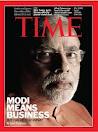
Gujarat Chief Minister Narendra Modi on the cover of the
26 March 2012 issue of the Time magazine of the U.S.


Hyderabad
17 March 2012

Making it to the cover of Time magazine may prompt two-time Gujarat chief minister Narendra Modi's followers to believe that he has it in him to lead India, but BJP's allies seem to think otherwise.

These parties seem to be making up their mind that the NDA's electoral prospects in the next parliamentary election, whenever it is called, would be better served without Modi in the lead. Some of them have suggested sotto-voce that the NDA could hope to become more acceptable to voters and allies -- present and potential -- alike, if the likes of a Narendra Modi or even an LK Advani are not projected as shadow premiers. They are calling it a minus formula, similar to the minus-one or minus-two formulae seen in the politics of neighbouring Bangladesh and Pakistan.

For one, the JD(U), which is the second largest constituent of the NDA, sees Modi as a liability and it does not fancy the idea of going to polls with him at the helm. More so, when JD(U) leader and Bihar chief minister Nitish Kumar himself is seen as a potential choice for prime minister. What goes in Nitish's favour, as compared to Modi, is the degree of acceptability towards him among non-BJP, non-Congress political parties, some of whom are coming together to constitute what is loosely being called a third or federal front comprising regional parties such as the Trinamul in West Bengal, BJD in Odisha, AIADMK in Tamil Nadu, and, now, SP in Uttar Pradesh, where Mulayam Singh Yadav's party has emerged the winner of the recently concluded Assembly election.

The third front is not without problems or internal contradictions, though. Complicating matters for this motley group is that there are many potential contenders for prime minister, including, but not limited to, Mamata Banerjee and Mulayam Singh Yadav. Already, Samajwadi Party sources have indicated that their next goal after getting a brute majority in the Uttar Pradesh Assembly is to make "Netaji", as Mulayam is called in his party, the prime minister. The SP has indicated its support to the UPA in the event of the Trinamul pulling out of the alliance and there it is speculated that the Congress could offer Mulayam a Cabinet berth to return the favour.

From the Deccan Chronicle, Bengaluru edition

From the Deccan Chronicle, Hyderabad edition

For its part, the Trinamul would not mind an early election because it is better placed than its rivals after winning the last Assembly election. However, if Congress veteran and finance minister Pranab Mukherjee is to be believed, Mamata has a huge challenge ahead of her simply because she is not fluent in Hindi. "If you don't know Hindi, you cannot be a prime minister. There are certain skills that are required for certain work. That is why Narasimha Rao became a good prime minister", Mr Mukherjee had famously remarked in 2009 when asked whether he was in contention for the top job. The language handicap notwithstanding, Mamata's Trinamul could emerge as the pivot of this front and a potential kingmaker in the event of a hung Parliament, where no party or alliance has absolute majority in the Lok Sabha.

Incidentally, the question asked about Modi has been used for Rahul Gandhi, too. A section of the Congress party is in favour of seeing the Gandhi scion succeed Prime Minister Manmohan Singh before the next parliamentary election, if only to enthuse party cadres and voters alike, but Congress President Sonia Gandhi has dismissed the possibility for now. Like cricketer Sachin Tendulkar, Dr Singh is faced with a career dilemma: they would want to know when is a good time to retire. Dr Singh's anxiety is compounded by the fact that for one who invested a large quantum of political capital in the UPA-1 on seeing the India-US nuclear deal through, even at the cost of risking his own government, he is today having to explain why nuclear projects in Tamil Nadu, Maharashtra and West Bengal have not taken off. Also, big-ticket reform measures such as entry of FDI of up to 51 per cent in multi-brand retail, or in insurance sector, has been put on hold for want of consensus among the UPA allies.